Sunday, 16 September 2012

Review: In the Realm of the Wolf


In the Realm of the Wolf
In the Realm of the Wolf by David Gemmell

My rating: 5 of 5 stars


You can take the wolf from the hunt, but never the hunt from the wolf.

The hunters are come. Men of blood and blade. The price on their prey’s head is far too rich a sum to ignore. A princely sum for a single death, and only a king’s ransom can pay it. But what is the true cost of trapping such a prey?

The hunted waits. A man of anguish and anger. The price on his head warrants answers. A sum for the Prince of Assassins, and his answers demand payment in kind.

Hunters, Mercenaries, a dark brotherhood, demons – all want for his death. Though he is but a man, the Assassin is caught in a web of destiny, one which will shape the world for years to come. The rise and fall of nations rest on his shoulders, but more importantly, the aim of his crossbow.

All know what is said about cornered beasts…

…The wolf returns.


David Gemmell’s ‘Waylander II: In the Realm of the Wolf’ is a return to the land of the Drenai, a direct sequel to his earlier title ‘Waylander’. The stage has already been set in the titular novel, but this second act breathes fresh life into old favourites and furthers the Drenai universe for the future stories.

Waylander returns in all his violent triumph. Cold-blood, calculated and lethal above all else. Set years after his initial appearance, the assassin has favoured his given name, Dakeyras, and settled down. He wed Danyal, and raised the girls Krylla and Muriel as his daughters. In a cruel twist of fate, Danyal died in a tragic accident. Krylla has wed and moved away. Muriel alone is left, but what sort of child can an assassin raise?

Dakeyras has been lost to grief. But, when he hears of the price on his head, Waylander returns. At first, it seems that he waits for his hunters to find him, ready for the final showdown, to die as he only knows how – fighting. When answers come to light, the hunted becomes the hunter. Death has always been his answer, and this time its personal.

As well as the return of familiar faces (Karnak the war hero, and Dardalion the Priest), we are introduced to an endearing host of fresh personalities. Angel, the weathered and weary gladiator, carrying scars that mark his years of carving out a bitter hardship in life. Senta, the conceited swordsman who hides a heart beneath a roguish smile. And Muriel, the lost little girl raised by a killer, now a grown woman who hides more than just herself in the shadows.

As ever, Gemmell writers with a pace for purpose rather than eloquence. The story drags the reader along at crossbow-point, held by the throat, swept up in an elemental storm. The action is visceral, sharp, and the developments are precise and delivered with the infinite surety of an assassin’s shot between the eyes.

Gemmell is a master of the ‘greater story’. As with ‘Waylander’, in which he tilts the hat to his debut ‘Legend’ by name-dropping, in ‘Waylander II’ Gemmell continues to interweave details, going so far as to highlight ‘Tenaka Khan – The King Beyond the Gate’ the protagonist from, funnily enough, ‘The King Beyond The Gate’. That, and a few tongue-in-cheek references to the questionable purpose of Dros Delnoch standing against the Nadir foe…it’ll never happen…will it?

Where ‘Waylander’ was a story of redemption, ‘Waylander II’ is a story of acceptance. Accept what has happened and what you are. But will or can happen can be changed, that in itself is a truth that must be accepted. Embrace life.

…or as Waylander does, take it.


View all my reviews

Sunday, 9 September 2012

Review: Waylander


Waylander
Waylander by David Gemmell

My rating: 5 of 5 stars


Can you put a price on redemption?

The King is dead, and thousands are set to follow him. Drenai land is swept into the tides of war. Enemy soldiers sweep across the country, butchering man, woman and babe. It is a dark time, and dark work is at play.

Can salvation be earned?

Dardalion is a man of the light, a dying light in the dark days. But, he must confront the evil, and to face it a man must walk the shadows.

Karnak is a hero, a beacon of hope in the night. He kindles fire in the hearts of men, but his ambition burns brighter than the sun – and there is only room for one sun in the sky.

Waylander is a dark man; a hunter and a killer. Neither light nor torch can burn bright beside him, but no shadow is too dark for him to walk.

War can be won by strength, bravery and the hearts of good men. Yet, there is a path of shadows where neither hero nor torch can stray. But only dark men can walk the shadows. There is only one man for the job. But can he be trusted to save the Drenai?

For he is an assassin – a traitor – the man who killed the king.

He is Waylander.


Waylander is the third novel that David Gemmell wrote in the Drenai series. Set before his debut ‘Legend’, Waylander provides a legacy to Gemmell’s later works. As with other works by the author, the theme of redemption runs strong throughout, and though good and evil are at odds, the shades of grey divide the battlefields.

The main drive, as with all of Gemmell’s novels, is the characterisation. From the Priest Dardalion who battles with his will to do good, to the General and war-hero Karnak, each and every soul in this book is well fleshed. That’s actually a good way of putting it. Soul. That’s what each of Gemmell’s characters embodies. They aren’t just fictional marionettes toyed with for the readers’ pleasure. They live, they breathe, they fight, love and laugh. They have soul. And, that is why I love Gemmell.

...and that’s without even tackling the title character! Waylander is the anti-hero to Gemmell’s Druss the Legend. But, Waylander’s tragedy and choices, in my eyes, make him a richer character in some respects. He doesn’t just earn his place in reader’s hearts, he fights for it.

Gemmell has always written with a sharpened quill, crisp and quick. The story is fast paced and action packed, keeping the reader hooked throughout. There’s little room to catch a breath, and the first time I read Waylander, there was little room for me to sleep seeing as I finished it in a single night.

As stated earlier, Waylander is set years before Legend. But, the novel sets up a legacy for the later book in the series, namely the warrior priest sect The Thirty, and Karnak. These extra touches, weaves and webs to a fully envisioned world, add an epic scale to the Drenai saga, creating a fully realised world that, though fictional, feels lived in.

There are small evils and small goods to all men. But men are still men, they do wrong and they do right. Gemmell was an author that explored the limited strengths of the human being, and showed us what it was like to be a man. He sets the standard for idols, role models, and heroes.

After reading Waylander...you’ll want to be a man.


View all my reviews

Tuesday, 4 September 2012

Creative Writing 101: Dialogue aka Talking to Yourself


‘Sticks and stones may break my bones, but names will never hurt me.’

‘Words are not worth the paper they are written on.’

‘Read aloud, it’s little but hot air.’

‘A picture paints a thousand words.’

     Interesting stuff, don’t you agree? Each of these carries a certain poetry, a deeper meaning, an understanding. I like these quotes, I do. They make for strong statements, and empowering edicts. They’ve been said before, and they’ve been said again, but they each started somewhere.

    Dialogue in a story follows each of these notions. These notions are dialogues in themselves. Today class, we’re going to explore dialogue, and how best to utilise this in your stories/novels/books/epics/scripts/pleas of innocence.

    (((Small print: Here at Emrys Evidence Evasions Ltd. We do not accept any liability for loss of limbs during a court case after the unseemly incident with the hamster and the spaghetti meatballs...)))

    Now, I’m not a professional when it comes to writing and the laws unto which it is judged, but I count myself as a dab hand at conversational skills. I may not be a world class orator, but I can hold my own over a cup of coffee and any given topic. But, being able to speak is very different to writing the ‘spoken word’, particularly in a story.

    Firstly, when writing dialogue make sure you’re in the character’s mindset. Once inside their head, start wagging the tongue and see what comes out. Dialogue should feel RIGHT for your character. For example, I have a village Blacksmith by the name of McGowan. He’s a simple man, with simple needs and simple complaints. So, when things go awry he doesn’t whine with a “The end of the world is nigh!” he shrugs and says “Fair’s fair.” I know McGowan, he’s one of my creations, so I make sure he sticks to his identity.

     In the same vein, as McGowan belongs to a fantasy realm, he doesn’t slip into slang or real world profanities such as “Heaven’s to betsy!” and “Oh my god!” No, no. McGowan would rather curse to the gods of HIS world e.g. “Fraid and Govannon’s bloodied blades! What was that?” Remember, when writing, your characters may exist in a different world, time, whatever, so they won’t always speak like you do! This can be fun too, as you can make up whatever you want – you’re a writer after all, that’s what you do!

    Avoid blocks of speech. Conversations aren’t once sided. Have characters reason things out between the two of them – you’re not going to get far with A telling B what to do, and B holding no opinion of his own and just nodding and agreeing...unless B is a wall, at which point you have a character and a wall...but now I’m straying from my point. See what I mean? I’ve just rambled. Because I’m talking to myself, and have no-one to respond. I’m dragging it on, and on, and on, and on, and on, and on, and on...ok, you get the idea.

     Also, with dialogue be aware that ‘tags’ aren’t always necessary. Not every sentence should finish with ‘he said’. I don’t say everything. Do you? I shout sometimes, I murmur, whisper, grunt, sigh etc. But don’t just limit yourself to speech tags. Throw in actions. For example: a shrug, a nod, a smile. If it important to note, however, that with the write dialogue, you won’t even need a tag, as the line itself should carry and portray the intent and delivery.

     Lastly, when writing dialogue...read it aloud. It’s dialogue! IT’S A CONVERSATION! If it doesn’t won’t when you speak it, how is it going to work when you read it? This is a simple fix that can improve your work a thousand-fold. Dialogue needs to flow naturally, roll off the tongue...or roll like an errant meatball hi-jacked by a hamster.

     Now, off to find that pesky rodent...I might just catch him red-handed (read: pawed) after handling the Italian sauced orb of his affections!

    Emrys.

    ((Small print: I neither own a hamster nor a meatball.))

    ((Smaller print: Nor do I know where the hamster nor the meatball came from in reference to this post...it’s been a long day.))

     ((Even Smaller print: No hamsters were harmed in the writing of this blog post.))

     ((Even Smaller Small print: No meatballs were harmed in the writing of this blog post.))

Monday, 3 September 2012

Book Review: 'King of Thorns' - Mark Lawrence


     In chess, there are pawns, knights, queens, bishops, and more. But, there are no Princes, so in this Game I have become a king. Chess is black and white, which suits me rather well. A black king. But where’s the read? There should be red, a lot of it. A lot of red, a lot of blood. Because, I’ve played all my pawns for check mate.

     I’ve got one castle, one knight, a queen and a king on my side of the board. But, there’s six boards against my one side. Surely that’s against the rules? Why am I complaining, I’ve never been one for rules, or played nicely with others.

     Maybe being the king isn’t all it’s cracked up to be?

     ...But being a player is.

      ‘King of Thorns’ is the second novel in Mark Lawrence’s ‘Broken Empire’ trilogy, following on from his fantastically dark and macabre debut ‘Prince of Thorns’.

     In ‘King of Thorns’ we return to Prince Honorous Jorg Ancrath’s sociopathic outlook, now seated upon a throne and declared a King. King Jorg, has a problem. A very big problem. Namely the knocking on his door...and boy are twenty thousand soldiers loud! The Prince of Arrow has rallied a six nation army to his cause, and seeks to unite or usurp those that stand against him. Jorg has never taken well to being told what to do, so even outnumbered as he is, and surrounded, he’s still going to play his hand.

     ‘King of Thorns’ is a complex addition to an already fleshed story, adding further depth to the fully blooded (literally!) characters and plot. Devices are sewn into the weave early on and are used throughout, making for some interesting developments and twists.

     Now, I mentioned ‘complex’. I won’t hold back, just like the savage bluntness of the book, but the story can be a multi-faced harbinger at times. At points the reader is engaged by current events, the first person PoV diary of another character, and the going’s on of four years previous. However, I think these have been worked wonderfully into the flow, allowing Lawrence to focus on face rather than choking purple world building from the pages. The pieces are already set on the board, so the games can begin!

     The Prince – well, now the King – Honorous Jorg Ancrath, is back and he’s on top form. Four years older, four years bloodier, Jorg has more than filled his boots. His scheming ways are still there, though arguably at a grander scale, but this older Jorg has something of an emotion conscience. Previously, Jorg was something of a logical killer, though his decisions were less a surgeon’s calculated scalpel and more the fall of an executioner’s maul (axes are too clean for the blood splatter than Jorg leaves in his wake). Now, Jorg has a devil on each shoulder, guiding an emotional bloodbath, and when it’s personal, it’s only going to end in tears.

     ‘King of Thorns’ is a real wing stretcher for Lawrence. Not only goes he flex his fingers by dabbling more so with the various weaves (switching from another character’s diary, a ‘past’ recollection, and the current crisis), he builds on his world to escalate the scale of his story...well, it’s not longer a story to me. It’s a saga. An ambitious saga, but it’s written in blood, and you can’t help but get swept up in the madness. In terms of style, Lawrence also let’s rip with some stitching one liners. His tongue in cheek quips had me in fits at points, and if you read this novel, I guarantee you’ll spot my single favourite sentence a mile off!

     And with the third and final installment on the way, with the promise of more bloodshed, and further twists and ties of the noose, things are certainly looking bright on that red horizon.

     Mark Lawrence, if I was hooked last time, this time I’m at knife-point.

Tuesday, 28 August 2012

Creative Writing 101: The Hook and the Start aka The bouquet of Nuclear Flowers


     Firstly, let me apologise for the delay in service! Been a busy week, but normal ‘viewing’ should resume from today!

     Is the hare really faster than the tortoise? Did the chicken come before the egg? Green means go, red means stop, but yellow means something in the middle – so half a stop, or half a go? What I’m trying to say is that everything starts somewhere. As writers, we have the godly say-so to decide everything about how our stories start.

     The most important thing to consider, in my opinion, is the fact that you need to open with a ‘hook’. The ‘hook’ is something that needs to grab the readers’ attention and will them to read on. There are various ways of doing this, from intrigue to conflict. Take for example, George R R Martin’s ‘A Game of Thrones’ (side note: I’ve yet to actually read the books, but I’ve read the first chapter and seen a bit of the series, so his hook has stayed with me long enough to convince me to read them at first opportunity). The first section the reader is introduced to is (without going into spoilers) the ‘out of the ordinary’ going’s on in the North. This is the opening hook – delivered in a dynamic scene. It’s a full chapter, and most importantly, it raises a question, a conflict, intrigue…the need to read on.

     For a writer, the hook is crucially important to those hoping to pursue the route of traditional publishing. As a general rule, agents request submissions of the first three(?) chapters / 50 pages / 10,000 words. If you’ve managed to land your manuscript on an agent’s desk, the only way to keep it out of the shredder is by instilling the ‘need to read’ (I hear bribes work too – that or a ‘shotgun read-through’ similar to a ‘shotgun wedding’).

     You’re opening has to catch the agent’s eye. An agent is a hunter-killer, not a hunter-gatherer. It’s natural habitat is the wild frontiers of the office, roaming the desks and outback of coffee-cup stains. It feeds on the hopes of freshly printed manuscripts, devouring printer ink, sparing only those worthy of passing through its territory. Prey is many, peers in prose are few to the predator. The only way to placate the agent? Lure it into a placid state, inspired by a story, delivered with a strong right hook! Agents have an acquired taste, they know what they’re looking for, and you have to prove that from the get-go.

     Don’t info dump at the start. Purple prose is not your friend. Info dumping is a tendency (read: DROP IT!) of writers (particularly fantasy and Sci-fi) to fill a character’s / situation’s / world’s backstory in a oner. A huge wall of text that’d send even the Hubble telescope cross-eyed. Without going into this in too much detail (and thus committing info dumping, myself) think of it like this: ‘you need to feed your reader a starter, but hold off on the main course. Don’t overfeed the reader, or they’ll grow bloated and will leave before desert; but don’t let them starve or they’ll bail early and go for a burger at the nearest fast food chain!’

     The opening needs to set the tone and the standard of the novel. Your reader has arrived under the pretence of a genre/story/idea that you have pitched, but if you stray from this oath you’ll likely lose them. For example, if your story is chick-lit, why start with the death of the world in some apocalyptic explosion caused by a power hungry maniac, wielding a bouquet of plutonium grown flowers. Don’t do this! 1) Because it’s my idea and I want to write it now! 2) because your reader is expecting something of a different vein.

     …3) I smell a bestseller! Move over Mr Mercury, or whatever your name was. I’ll even help you pack up your paddle.

     Lastly, let’s go back to firstly (chicken or the egg approach – see what I’m doing here?). The ‘hook’. The sharpest part of any hook is the point, and in this case, the first sentence or the first fifty words or so. No, ‘The sun was shining, the sky was blue, the grass was green, the bunny rabbit hopped through the wood, and the ruddy ice cream van ran me over whilst the puppy dog farted.’ That’s a little odd, and I’ve massively strayed from the point, but it’ll do. As a writer, I favour an opening hook in the form of dialogue, or a character’s inner monologue. Take for example ‘hooks’ from some of my own work:

From Man to Man Part 1: 'I never meant to let you down.'

From Man to Man Part 2: 'So, it's come to this?'

From Man to Man Part 3: 'Any coin's a coin.'

And, as a treat, the opening to It Began With Ashes:
     
     “Are we being followed, father?”
     
     “No, Astartes, we are not being followed.”
     
     “How can you be sure? You didn’t even look!” Astartes whined. Struggling to turn in the saddle behind his father, Astartes craned his neck to look back through the night.  The dirt track meandered this way and that, winding through the Emberfen Forest. The path was hard to make out amongst the muddy browns of the woodland, made all the more difficult by the thick canopy obscuring the glow of the stars and moon overhead.
               
     Nicolas shook his head, scratching idly at his flame-red moustache. “Don’t let your eyes play tricks on you, son...there’s nothing out there.”

     Now, to the red, the egg, but then again maybe the chicken, the finish line where the hare or the tortoise is waiting. Use your hooks wisely, keep ‘em sharp, but if all else fails resort to nuclear fertilized shrubbery. You’ll have to excuse me now as I’m off to pick me a bouquet of flowers from this glowing patch of dirt, charming little garden mind you. Saw a three eyed dog there the other day.

     Emrys

Monday, 20 August 2012

Review: Prince of Thorns


Prince of Thorns
Prince of Thorns by Mark Lawrence

My rating: 5 of 5 stars


‘Is it true that we need to be broken before we can be reborn? No. But bleeding can sure do the trick.

Thorns can bleed you better than a knife. Briar thorns so deep they hook to the bone. Where a knife goes in and out, you go in and out of a thicket. The knife goes in, blood comes out. You go in…who knows what comes out? But, I did.

Before the thorns, before the person that I am now, I was a son and a brother. I’m still a Prince, but I gave that up for the road. Being a son and a brother was taken from me. The thorns gave me a new family. Brothers, though not by blood, but they’ve spilled enough of it for me. Yet there’s more blood to run, and though I lost my old family, I still have a claim to the family fortune.

And that fortune is a throne…’

Prince of Thorns is the stunningly dark debut by Mark Lawrence. In my opinion a noir-fantasy, the novel is the first part of a trilogy known as ‘The Broken Empire’.

The reader is introduced to Prince Honorous Jorg Ancrath, a fourteen year old boy-Prince who leads his ‘brothers’, a band of bloodied outlaws, across the land, raiding, raping and razing. Jorg’s dark path has an end in sight, that of winning the game of thrones. His quest for the revenge of his brother and mother’s murders has set him on the path for his father’s throne, and later, the title of Emperor.

I found myself drawn along by this book, fascinated with Jorg’s decisions and insights. Written in a first person point-of-view, the reader is able to see the Prince’s rationale, and though might not commit themselves to similar actions, the philosophy of the sociopath is addictive.

Without saying too much and spoiling it for those of you who do decide to read this book, the story has more than a few surprises in terms of world building and setting. Personally, I think that this is one of the best conceptualised fantasies of the year, despite the mixed reviews that I have seen.

Not only are the characters, the setting, the pace, and the voice masterfully wrought, but the overarching plot and the ‘behind-the-scenes-grand-scheme’ are of equal measure. On one hand, Prince of Thorns works as a marvellous standalone novel, but on the other its already got me itching for the next in the series.

Mark Lawrence…you’ve certainly got me hooked.


View all my reviews

Friday, 17 August 2012

DeviantArtist Feature #4: Terribilus


     It's that time again, and boy do I have a treat for you this week. On my travels this week, whilst looking for an unsung artist on DA, I came across a real gem. A buried treasure that everyone seems to have walked past whilst looking to the sky for answers. But, I'm a bit of a treasure finder, so I'll give you a map and a compass to join me in my search. Don't worry about bringing spare bags to carry it all, as this treasure is one you'll want to visit again and again. Without further ado, I present this week's DeviantArtist Feature:


     Terribilus is a FANTASTIC artist from Bulgaria. He's been a Deviant for 3 years, knocking out 80 deviations in that time, and each of them is AMAZING. Yet, I don't think he's received the recognition he deserves, so...Friends, Roman, lend me yours eyes!


     Beautiful. That's all I can think of when looking at this. It looks like the front cover of a novel if you ask me. And I'd definitely buy the book! The detail on the warrior in the main is amazing, but the attention to the battle in the background is the real awe inspirer here. Rather than skimp on the 'setting' Terribilus has brought the foreground to life by giving it something to exist within.


     Friends, Romans....Walruses? (Is that plural for Walrus? Or is it Walrusi? Hmm, food for thought!)
     Lend me your...tusks? (Sorry, I couldn't resist).
     Honestly, at first glance I thought this was real. My whole belief in evolution was shattered. No, but seriously, this artwork is amazing. Terribilus has adapted the creature to a humanoid stature, perfectly fitting the armour of a Roman Legionnaire.


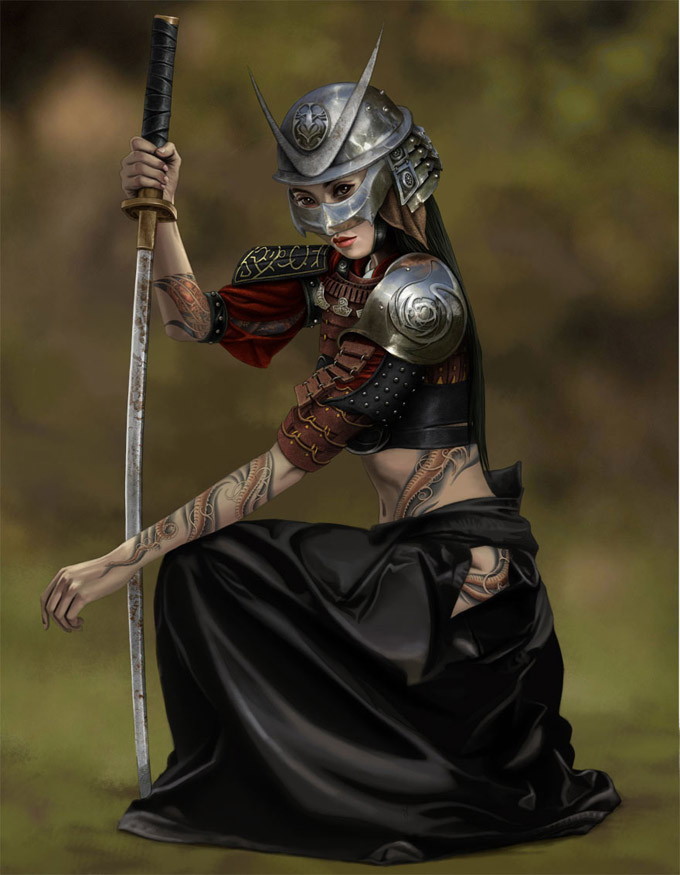
     Another one that I thought real. 'Izumi' embodies the beautiful yet deadly soul of the samurai. The contrast between silky cloths, elegant tattoos, rugged armour and marred weapon, have been expertly exercised. The character's pose is far from the easiest to align, but Terribilus has wrought it wonderfully.

     This is just a taster of the veritable treasure trove waiting in Terriblus' gallery! Honestly, check it out, you won't be disappointed!

     Muchos love,
     Emrys.