Friday, 2 August 2013

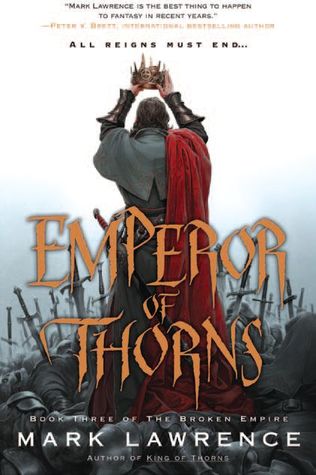
Book Review: 'Emperor of Thorns' by Mark Lawrence


My world has ended.

And it’s all because of Mark Lawrence.

‘Emperor of Thorns’ was released yesterday in the UK, and even at a hefty 592 pages I finished it this morning…Rome might not have been built in a day, but like I said at the beginning of this review, Mark Lawrence has ended my world in less than 24 hours.

If you’re unfamiliar with Lawrence’s ‘Broken Empire’ trilogy, then you must have been sleeping under a rock for the past few years because its gathered so much attention from reviewer and reader alike that Jorg has all but become a household name. People have at once flocked to Lawrence’s banner, showering praise and pleasantries for his talents, whilst others have been up in arms, accusing him of ‘needless animal cruelty’ or ‘over indulging in the rapey-ness’ within fantasy.

Me? I’ve got my pitchfork out, not to join the mob of naysayers, but to rally to Lawrence’s cause.

I like ‘The Broken Empire’ trilogy.

No.

I FREAKING love it.

To a reader, the main character Jorg Ancrath, is like that kid at school your parents warn you to stay away from. He doesn’t listen in class, he’s never on time, never tucks his shirt in, can never keep himself out of trouble…locks the janitor in the closet, shaves the school cat, sets fire to the science lab because it’s funny to wedge magnesium strips in the top of teacher’s lighter. Jorg is dangerous – and he knows it.

That’s the sheer beauty of it.

If you thought Geoffrey Lannister was a loathsome, wicked, evil, decrepit, malignant, hateful, blasphemous…how do I put this…fucker, then you haven’t met Jorg yet. Jorg is worse, for one simple reason. He’s aware of what he’s doing, which is also the reason why you fall in love with him.

Like that kid at school, you can’t stay away. It’s impossible. You’re intrigued, you want to know more. And, after all, it’s better to have him as a friend than an enemy.

In ‘Emperor of Thorns’ Jorg sets out to do what his creator, Lawrence, has so successfully done. Get people to flock to his banner. Namely the kingdoms of the Hundred. But it’s not the living that Jorg has to worry about, it’s the Dead King and his army…

So, in a story where existence as we know it has been totally and utterly destroyed after nuclear war, where the Dead rise…you can see why I say my world has ended.

You’d be wrong.

My world ended when the story did. Lawrence is a master of weaving – dropping plot devices here and there, scattering them far and wide. Through split time narratives, at first, the reader debates whether these little additions have purpose other than to add colour. It’s safe to say that NOT A SINGLE ONE OF THEM is wasted. Forgive me for using the tapestry example, but Lawrence weaves thread after thread into a grand masterpiece, and when it’s done he lays it at your feet for your admiration. It’s beautiful, one of a kind. You take a step closer to get a better look...

…Then he rips it right out from underneath you, leaving you flat on your ass, bewildered, shocked.

And then you smile. With an ending like that what else can you do but smile? There’s no other fitting way to finish Jorg’s story other than that. It’s perfect. For readers it’ll definitely have a Marmite effect – you’ll either love it or you’ll hate it. In ‘Emperor of Thorns’s case, however, I reckon you’ll either ram it into every available orifice you crave it so much, or you’ll poison yourself with it.

Because this trilogy was that good, because it came to life on the pages, because I wanted it to go on forever…when I finished it, my world came to an end.


Touché, Mark Lawrence, Tou-bloody-ché.

Thursday, 1 August 2013

For Success (Writing or otherwise) you Need only Remember One thing.


As a writer I deal day-to-day withpeople in the real world and the fictional ones I create. Most of the time the fictional ones exist on paper, or on the computer screen. However, real people exist on my computer, too.

Now, wait a minute, I hear you. You're thinking poor D has gone mad, eh? People living in his computer? Taking dinner on his disc drive, holidays down the USB cable to chill out in the External Hard drive?

People ARE on my computer - they're on yours too. The second you bring up Facebook, Twitter, Linkedin or RussianCamBrides.org(asm) you're going to encounter real people - not fictional ones.

Whether you're looking for the 'quick fix' to all of life's little problems, trying to get yourself out there, get noticed, twist someone's arm into reading your stories, sell books, or just meet others (friends / fans / a new bride)...

For SUCCESS, above all else, you ONLY NEED to remember one thing...

...everyone is a person, just like YOU.

Interpret this how you will.

In terms of life, reality, and the whole universe this statement boils down to one fact. Whoever you interact with - be it via physically or orally (NOT LIKE THAT) in the corporeal world, or via instant messaging or social media on the digital realm - whoever you're talking to, they're a person too. Without getting all Jesus, Mohammed, Ronald McDonald on you, remember the saying 'treat others how you'd like to be treated'?

But in terms of being a writer, consider the above statement in line with these two points:

1) Your characters are people too. Give them depth, believability, sustenance. I've never met something without a back story, have you? On the flip side, even though everyone has a story to tell, not everyone does tell it. Sure my postman might be an ex-convict who served 8 years for put melons down his shirt on a late night flight to Bahrain, and danced up and down the aisle convincing passengers he was the real Kim Kardashian...but he hasn't told me that.

2) Handing the reader a character on a plate and saying 'tuck in' will inevitably leave them wondering what's for desert. By keeping back that history and back story we just talked about, you allow for twists, realisations and revelations.

I could waffle on all day and take these points to twenty and above, exploring the depths of characters, their symbolism and beyond, but scroll back up to the bold statement and read it again.

See it yet?

No?

Let me spell it out for you.

SUCCESS - ONLY - NEED - YOU.

After all, we all have to start somewhere.

Wednesday, 31 July 2013

Creative Writing 101: Answering 'What am I supposed to write?'

What am I supposed to write?

If I had a penny for every time a writer asked me this…I could probably buy a Starbucks to fuel a chapter’s worth. If I had a penny for every time I asked myself the same question I could make that coffee a large one.

Back before I started getting under-way with my own writing this question would crop up a lot. And when it did it was a sudden and as sharp as an all-too-hot mouthful of coffee down the ‘wrong hole’, leaving me spluttering and gasping, reaching for the napkins to clean up the mess I’d made on the papers…

…please, people, let’s keep this clean and not read into that statement? I might have handed you a double entendre on a plate, but there’s no reason to slow-cook me over a spit roast of my own oddities.

Returning to the matter at hand. What are you supposed to write?

I don’t know, why are you asking me? But more importantly, why are you asking yourself?

Writer’s write because they want to. Because they can – because they have a story to tell. If you’re wondering what you’re supposed to write, look a little closer at your story plan and wonder what’s missing. That might be why you’re asking yourself this in the first place.

But, and this is a BIG BUT, if you’re asking yourself ‘What am I SUPPOSED to write?’ then you need to dissect your intent. Is it because you want people to like your story? Is it because you want to be the next ‘50 Shades of a Vampire’s Sparkly Skin with a side of Philosopher’s Stone’?

If that is the case…STOP! Put down the pen before you hurt yourself, I beg of you.

The dangers of trying to write the next big thing are an endless catalogue that’d make thumbscrews seem like a pedicure. There’s no harm in big ambition, actually I encourage and applaud it, and if you’re taking a not-so-popular trope and prodding it toward the limelight then good on you. But penning yet another ‘that’s popular so it’ll sell well’ book might actually leave you out in open water, with a longer swim back to shore once the tide’s abandoned you.

What I’m trying to get at here is: when you write, the first person who is going to read your work is going to be you. And for most writers your biggest critic is always going to be YOU (unless you have a dog like mine who you subject to orating first drafts to). Imagine this: between worrying so much about ‘what you’re supposed to write’ you end up scrawling something you think the reader will like, but when you end up going over it you in fact detest it…

The tide moves pretty fast out there in the sea of writer world, doesn’t it? And low and behold the sharks of doubt have started circling.

WRITE what YOU WANT to WRITE. I cannot stress how important this is. If you don’t enjoy the process how do you expect to get to the end? The reader will pick up on the fact that you’re second-guessing yourself, and the story itself will lack the conviction and honest delivery it truly deserves.

So the next time you ask yourself ‘what am I supposed to write?’ answer, simply, with this.

‘My story’.


That, or hire a dozen monkeys and force them to the typewriters.


((Note: No monkeys or sharks were harmed in the writing of this post, but my dog did get a little bored of hearing me speak out loud as I typed...and no, that's not him in the picture.))

Monday, 29 July 2013

Fantasy Vs Reality


Fantasy versus reality...

I'm going to do a much more comprehensive blog post on this at a later date but I thought it'd be a good headline for this one. As you can see I've been on radio silence since the end of April. No writing, no blogs, no reviews. Heck, I've even let my commitment to writing articles for Fantasy Faction slip.

That, my friends, is reality's fault.

I've just left the Army, and the civilian world is a gut-punch if I've ever felt one. The safety net that's always been there (well, not so much when I was parachuting) has been rolled up and carried off. During this time I've been doing the usual job hunting and temping whilst deciding on a more permanent career field, and also redecorating the back bedroom ready for the new arrival to the family in October. My fiancée and I are expecting our first baby, a little boy, and we're so excited (me because I get to raise him with a love of fairy tales, myths, legends and fantasy - her because she can't wait to get a full night's sleep without the baby kicking her from the inside out).

So my fantasy - my writer/blogger alter ego D. E. M. Emrys (yes, this isn't my real name) - has been forced to step aside for reality for awhile.

BUT NO MORE!

That's right, I'm stepping back into the saddle and taking the reins of this mighty steed.

In the spirit of fantasy vs reality, I want YOU, yes YOU buddy, with your keyboard and your mouse and your now widening smile, to take a moment to do something to aid the fantasy vs reality crisis. How? Well, let me tell you...

The David Gemmell Legend Award is a pretty prestigious event - it's a celebration of the who's who in current fantasy literature. With three qualifying categories: Legend (best release of the year), Morningstar (best debut), and Ravenheart (best cover). If you're a fantasy reader be sure to head on over to http://gemmellaward.ning.com/ NOW as voting ends on 31st July. Take 5 minutes of your day (wow, this is beginning to sound like a charity advert) to turn your love of fantasy into a reality for an author, and vote for their work.

Me? I've already voted. I won't tell you who for, yet, but for those of you who have followed this blog you'll be able to guess who. All I can say is best of luck to all the candidates! Fingers crossed, one day I'll elbow my way onto the long list - as might some of you hopeful reader/writers - but until then, let's show our favourite authors our appreciation and make their fantasy's a reality.

CUE CHEESY MUSIC, LIGHTS DIM, JAZZ HANDS!!!

Tuesday, 30 April 2013

Interview: Sci-fi Author, Doug Strider.

I featured Doug on written-with-a-sword a few weeks back, and he was kind enough to allow me to not only review his ebook 'Space Danger!' for your enjoyment, but also submit a guest post about himself. Now, to top it all off I thought I'd invite Doug back for a short interview. I also have the pleasure of meeting Doug in person at an author event in London, and I must say he's a top bloke! Let's find out a little more about the enigmatic and intrepid galactic explorer turned comedian!


1.      For the benefit of those who might not know you prior to this interview, please introduce and tell us a little about yourself.
My pen name, for reasons that are as mundane as an afternoon searching through Google for something relatively unique, is Doug Strider.
I have been, and still seem to be, involved in podcasts such as The BoxRoom Podcast, DWO-Whocast, Lost Bearings, Soldiers of Tangent and The Bearcast. The last two are still stuck with me inside them like a comedy parasite putting posters up in their intestines and ordering pizzas with someone else’s credit card.
I’ve been a writer for over 20 years. This is a bit of a fib. I wrote some things 20 years ago and then had a 20 year break because of reasons but now I’m back, cursing Word and developing a superlative beer tummy (although I’m also fighting it, no idea which side is going to win).
2.      What is the name of your most recent book and if you had to sum it up in 20 or less words, what would you say?
Space Danger! Which is a sci-fi, space-pulp-opera type affair. To sum it up I’d say: The second-best crew in the fleet are given the task of saving the galaxy. Probably.

3.      What inspired you to write this book? And how are your story ideas born?
Always loved sci-fi. It’s one thing my dad and I had in common. My earliest memories are of me playing as a space hero so I thought that getting back into my first genre love would be a fantastic re-starting point.
It was originally going to be an audio comedy/drama adventure in collaboration with Danny Davies (who I do The Bearcast and Soldiers of Tangent with) but I asked if he wouldn’t mind me doing a novel of it instead and he was happy for me to go ahead.
Story ideas are usually born of idle speculation about stuff when I’m standing outside having a cigarette and staring vacantly into the heavens. I’ve lost so many ideas though so I’ve managed to start writing the damn things down. Generally they come from what-ifs.
4.      What was the hardest part of writing your book? And if you had to do it all over again, would you change anything in your book?
The hardest part is finding the time! It’s mostly written in the pub on the way home of an evening, hence the battle of the tummy barrel, so I have to figure out something else really. This method of writing a few hundred, or less, words at a time eventually works though, it soon builds up, but it can feel a little disjointed writing in small bursts. Remarkably it seems to flow rather well when I read it all back. Then I edit the shit out of it to make sure it flows.
I don’t think I’d change anything in the book so far. Will see how I feel further down the line. Maybe when I’m in a bit of a mood so I can call myself an idiot and have a fight with myself (then buy myself a bottle of red wine to make amends. Any excuse really!).
5.      Did you learn anything from writing your book and what was it?
If you frequent a pub long enough they give you a free drink at Christmas.
That and I’m rubbish at planning. Background characters pushed their way to the front and made me make them main characters, the cheeky buggers. Also, the destination I want them to go is ignored because of the “What’s that over there?” factor and they go trundling off over there and I’m left looking like a fool as I write down what I didn’t expect them to be doing.
6.      Do you have a favourite line or scene from your latest release?
I have a particular fondness for two scenes in particular. The first where Midshipman Harris is suffering the temporal bends and for no reason known to himself, or science, mimes paying for an orange. The second is the escape pod scene further in with the third rule of survival (I’ll not spoil that one!).
7.      Is there a message in your novel that you want readers to grasp?
Not as such. Not really. This isn’t about the best ship in the fleet, or the worst. It’s about the second-best. At a push I’d say it’s more about living with that realisation, or grumbling about it incessantly, and remaining British in the face of everything.
8.      Can you tell us anything about your next book?
I’m releasing Space Danger! in four parts and am still working on Part 3 at the moment. But I do have plans for my next project. Ideas are forming, characters are peering out of the smog and dropping me notes to say whether they’re available or not, the spirit of London is peering closely at my thoughts and disapproving mildly, and there are small, strange things skittering around my feet that I’ve only caught glimpse of out the corner of my eye.
9.      Do you normally read other books in the same genre of your own?
Yup. Mostly! Sci-fi and fantasy are my genres of choice so I flit between them like a dog with two owners calling my name. I’m trying to avoid reading too much sci-fi while I’m writing in that genre though. Likewise my next project is more fantasy based so will avoid that type of stuff when I’m working on it. I hate to read things back and go, “Hang on a second, that idea is from so-and-so. Bugger. Delete.”
10.   Who is your favourite author and what is it that really strikes you about their work?
I can’t really say I have one definitive favourite. I’m a keen observer of the worlds of Robert Rankin, Douglas Adams, Terry Pratchett, Stephen Baxter, David Gemmell. Those off the top of my head.  I tend to steer towards the more absurd than anything. Otherwise it’s atmosphere and stopping every now and then to stare dumbly at the universe while I have a really good think about things.
11.   What books have made it onto your wishlist recently? And why?
I really should get a wishlist. How much do they cost?
I’m a uselessly random book buyer. I get recommendations from my partner Jen, Twitter acquaintances and I wake up sometimes with a new book on my Kindle that was completely down to a drunken whim.
I’ve recently read the PC Grant books by Ben Aaronovitch and am this close to pre-ordering his new one Broken Homes which is out in July.  So that probably counts. I really got drawn into his London, the police procedure and the “weird shit” that is forcibly suppressed by those in charge which is getting rather more tricky the more Grant fucks things up. Great stuff!
12.   Any advice for other writers/indie authors out there? And what’s the best advice that you have been given when it comes to writing?
If you think you can’t write then you’re probably wrong. Try it. You might like it. If you’re right then have a biscuit, a cup of tea and then try again.
If you want to write then write. See where it takes you. Take a notepad, jot down ideas as they occur. Work on one project at a time!
It is also considered good luck to buy me a beer. I don’t know why. I don’t make the rules.

Friday, 26 April 2013

Review: The Grim Company


The Grim Company
The Grim Company by Luke Scull

My rating: 5 of 5 stars


The Good: A promising debut set in a truly epic world, with gritty, relatable characters, and a page burner of a plot (yes, that's right, a page burner).

The Bad: In my opinion I don’t think there is a lot that is BAD about ‘The Grim Company’ – I’ve seen the pointed finger on a lot of reviews, but I’ll try and clarify my thoughts on the ‘grimdark’ and ‘Abercrombie mk2’ here.

The Ugly Truth: The Grim Company is a hugely impressive debut. Yes, it’s Grimdark. Yes, it’s comparable to Joe Abercrombie. But if you’re going to write a grimdark novel OF COURSE you’re going to be compared to JA. It’s like writing a novel about elves and dwarves but hoping not to be compared to Tolkien. What the Grim Company does do, and does very well, is entertain. It’s unashamed of its roots, which to me is all that counts. Don’t shout and scream that it’s ‘just a copy’ – it’s not. It’s a tilt of the hat, a nod in the direction of, but in my opinion it’s a very strong contender in today’s fantasy market able to stand on its own two legs (unless you’re an unfortunate mage like Eremul, of course!).

For Those That Like: David Gemmell, Brian McLellan, magic based stories, grimdark, gritty characters, tyrant-overthrowing-plots, and oh alright then I’ll say it, JOE ABERCROMBIE.

The gods are dead.

Magic is dying.

Freedom isn’t far off being terminal, either.

Dorminia is a city under siege from within. The Tyrant of Dorminia rules with the approach of: hear no evil, see no evil, do no evil. ‘Evil’ being anyone with motive to oppose him. His mindhawks can hear the thoughts of the people, the city watch see everything, and if anyone steps out of place then Salazar’s magically powered Augmentors sort it out. Swiftly.

But ‘evil’ is in the eye of the beholder. One man’s hero is another man’s villain. Salazar himself is a hero for overthrowing the gods hundreds of years ago, but what about the men who seek to overthrow Salazar?

Two ageing barbarians, one with bad knees and the other with a bad temper, aren’t your typical everyday heroic pair. Nor is a cocky hot-headed youth who claims to be a hero at every opportunity. And a ‘half mage’ with no legs barely scratches at being 'half man', and there’s no such thing as a ‘half hero’. But together with a band of rebels, they seek to bring down Salazar and liberate Dorminia.


Luke Scull’s ‘The Grim Company’ is his debut novel, and the opening to a brand new epic fantasy series. ‘The Grim Company’ is a story of the unlikeliest companions thrown together to bring down an enemy that even the gods couldn’t defeat. The odds of their success are grim (see what I did there? Ok, I’ll stop!).

You need a fitting start to a tale in which the gods are dead. It needs to be a cataclysmic intro, something world-shattering to live up to the epic setting. What to choose, what to choose…oh, I know! A tidal wave. Eureka. Wait…

…A TIDAL WAVE?!? In the first five pages?

Certainly sets the tone, doesn’t it?

‘The Grim Company’ comes out swinging, and throughout it doesn’t pull its punches. Look, I’m not going to go into the similarities that other reviewers have pointed out just yet, because I think that ‘The Grim Company’ can stand on its own two feet and fend for itself in terms of originality. Sure it’s grimdark fantasy, which is all the trend at the minute, but it has its own unique spice. I won’t bore you to death with examples but here’s a tidbit for you. Without spoiling anything, Scull introduces the concept of deep-sea mining at one point in the story. DEEP SEA MINING IN A FANTASY?!? Stick that in your originality pipe and smoke it. Then you have the concept of the Augmentors, warriors with a specific talent or trait magically magnified. Yes, this concept (or at least the base idea of it) has been used numerous times in fantasy, but it’s execution in the story is fantastic and makes for some fantastic character development and twists.

Scull shamelessly man’s his ‘Grim Company’ with the unlikeliest of heroes, even though each stereotype is likely to appear in every other grimdark fantasy novel out there. BUT, and I must emphasise this point, BUT Scull does it SHAMELESSLY. Ageing barbarian with aches and pains, getting too old for the life of a warrior; a crippled and bitter intellect, seated at the heart of a conspiracy yet he can’t sit down or stand up without risking sh**ting himself; and a hopeful young hero, talented, brave, destined for greatness, that is if he can stop his ego from running away from him. They’re all familiar to a fantasy fan, but don’t be put off by thinking this is a copy-paste cast. It’s a testament to Scull’s writing that he can take such familiar characters and breathe new life into them. I myself fell in love with the characters. Yes I can see the similarities. Do I care? No. They’re individual to me.

The plot and the setting are fantastic. Who doesn’t like an epic backdrop to a fantasy? And it doesn’t get much better than dead gods who corpses leak magic. Seriously, top this, go on, I dare ya.

Scull’s style is refreshing. I mean when you weigh it all up he has PACKED ‘The Grim Company’ with ideas and characters. When you try and list them all down, it seems like it won’t work on paper. There's just so much going on. But it does. It really, really does. The pacing is fantastic, never relenting. It’s not so much a page turner as a page burner.

But the heart of the matter, I guess, the thing that everyone wants to know:

…is ‘The Grim Company’ just another grimdark, or is it (as a minority of reviews/readers suggest) a blatant copy of other things out there (He-who-shall-not-be-named!).

In my opinion?

NO!

‘The Grim Company’ is its own story. I used this word earlier, SHAMELESS. It is shameless in its use of characters, tone, and even word choice. But what does it have to be ashamed of? Nothing if you ask me. It’s a damn good read from a damned good author. I’m not going to point out the similarities for you, because in my opinion that’s not me doing justice to Luke Scull or ‘The Grim Company’.

If every reader in the known world wants to know the TRUTH about this similarity binge, I’ll give you a truth. You might not be able to handle it, but here it is.

Is ‘The Grim Company’ a mirror of Joe Abercrombie’s ‘First Law’ series?

No.

As a debut novel, ‘The Grim Company’ is better.


View all my reviews

Thursday, 25 April 2013

Guest Post: Lee Anna Estein on Editing!

Today I've invited an old writer friend of mine, Lee Anna Estein to talk about the 'joys' of editing!

I have been asked to write a blog post by Mr. Emrys to cover when to finish editing your first book because we writers are a neurotic bunch who want it to be absolutely perfect. Some writers spend 20 years trying to make the first one just right.

You see, it's a topic I find rarely covered, and so I'm going to struggle through this. What makes me qualified to write this post? Well, I'm a writer working on editing my first book. Yes. I have finished writing it, and I'm now "polishing shit."

So, what will I talk about in a topic so broad? I have to start at the beginning. I'll cover something that a lot of new writers are using these days, online writing communities. They're popular because you can just throw your vomit up on the interwebs, and you don't have to pay for people's opinions. Not everyone on there hopes to become rich and famous, but a large percentage want to get published. A lot of these people with gleaming eyes hope to get the feedback they need to prepare their book for agent hunting, or that an agent will pick it up right off the internet, no work required.

Here is the problem. How many people use the internet? How many people will find your book and give you helpful feedback? Yeah, that's what I thought. Not many, so you end up floundering in the dark with your arms flailing because you don't know where to start or what needs fixing.

First, brush up on your grammar. You'll need it. Get a dictionary and thesaurus. Learn how to use them.

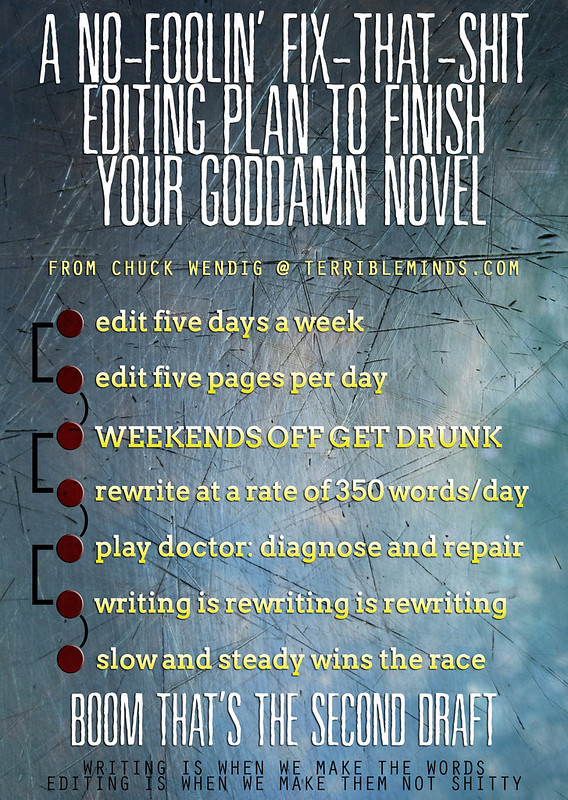
Second, I will point you in the direction of Chuck Wendig's wonderful post on editing so you get it done. (Warning, does contain profanity, but he is genius.) Seriously, read it. It's great advice. And here's his neat info-graphic he says anyone can share:


Okay, now that I've given you someone else's advice, onto mine.

So someone gives you feed back on your book. You don't know this person. They aren't your mom, your second cousin, or your neighbor who runs around outside in his underwear after he's had too much tequila. Their name might be their real one, or it might be their pseudonym, or it could be a screen name like OtakuYaoiShipper20. Either way, they took the time to read your book and your looking for something juicy that can help you fix your work.

Warning! The words critique, criticism, and critic are not negative! Do not have a panic attack upon seeing them in use. It's part of the business.

Here is a list of the kind of people and responses you might get:

The Ego-stroker: This is the most common response you will get. They read your stuff and like it. They'll tell you everything they loved about it. They'll shout it to the heavens and want to have it's babies. Here is the problem, they can't help you with the technical issues or the plot issues or the fact that your hunky hero is unintentionally a giant douche because they're too wrapped up in their own fantasies. They pat you on the head and tell you you've been a good doggie. These people are the reason why a lot of bad fiction gets published. Don't listen to them. Their words are like eating nothing but junk food. It blows you up but doesn't actually do anything for you.

The Troll: They hate everyone. They hate that you breathe. Don't take what they say personally. They will rip on everything without saying anything constructive. They're the opposite of the Ego-stroker. They just want to hurt you.

The Helpful: They come in many different shapes and sizes. How can you tell they aren't the two listed above, they try to point out your mistakes with concrete examples and try to give you suggestions or resources you can use to try and fix them. On the flip-side, they also tell you what you're doing right and why. Or they at least try too. Good criticism is hard to come by. It can be polarizing or keep repeating the same thing. They can sound like an Ego-stroker, or a complete Troll. It is so extremely varied that you will bang your head against the wall trying to figure out who is right. Here is the kicker, it's just their opinion. That's right. Opinion. They might be completely wrong. No one knows your work better than you.

Now that you have your criticism, it's up to you. You have to open to whatever has been said, but you have to take it all with a grain of salt too. If you think your shit don't stink, than you won't be able to absorb any helpful advice. (And you probably wouldn't be reading this.) If you're too open, your brain might fall out and you could end up fixing things that don't need fixed. As a writer, you have to find what will work for your story. Here is some of the things I keep in mind:

How often have certain aspects/parts of your story been referred too? How often have critics told you that your protagonist was too whiney and childish? How many have said they want more background to your world? How many have told you about the Texas sized plot hole in the middle of your story? Keep track. One isn't usually enough, but sometimes it is. If you agree that your dialogue could use a little work, don't be afraid to change it and then run it by more people.

How reputable is the critic? I'm not saying that they need a degree or to work as a writer. (Although, that would awesome). Look at the other critiques they have written and any responses to topics on discussion forums. You can usually tell if someone knows what they're speaking about, or if they have some idea. If they have some of their own stories up, check those out too. See how they respond to criticism of their work.

Be polite. This should go without saying. DO NOT disrespect someone who has taken the time to read your work. It is time consuming. They had other things to do, but they took time out of their day to try and help you. Calling them names, ranting, and raving are not good behavior. It is not professional. Don't like what they say, suck it up and thank them. If you wish clarity on what they said, then ask for it nicely. If you disagree, but they have said something you still want help with, let them know as nice as you can. Arguing doesn't have to be all shouting and screaming. I've seen intelligent debates go down between people with radically different viewpoints that make the rest of the internet look shameful. DO NOT reduce yourself to a YouTube comment.

So where do these helpful people exist. Personally, I'm a big fan of Book Country. The site is filled with intelligent and nice people who just want to help. There is the occasional best seller floating around, and 3 people have been picked up by publishers and agents that I know of. Even though their star ranking system is under scrutiny by their users, they really want to make it useful. Many a member has tried branching out to other writing sites, only to run back. It's one of the few places not ruled by Ego-strokers and Trolls. (We do have the occasional old curmudgeon, but he's harmless and can be quite helpful.)

So, what does this have to do when figuring out when your book is ready to be whored around to agents and publishers like a starving starlet? Here's the problem. You really don't. You can only fix most of the problems before it's clean enough to show off. The best thing I've ever heard was that we never finish art, we only abandon it. There may come a time when all the advice in the world and all your hard work are no longer needed. Sure, there will always be things you have to fix, but you need to limit yourself. You can overwork your writing. Set yourself limits and hope it's enough.

Sorry if the ending was a bit anti-climatic. That's the truth of it. It may take a couple rejection letters to tell you what you need to do. Just don't be lazy. The more you work on it now, the faster it will go. Editing is writing. Not everyone realizes that, but there's the truth for you. Dive into it like you did the words-to-paper part, and it won't take 20 years.

I'm working on a major edit right now that I'm workshopping in a couple of places. I hope after one more run through, it'll be close enough to show off to professionals. Now all I have to do is get my butt in gear and get over the intimidation of pages that look like this:


I never said it was going to be easy.