Showing posts with label self. Show all posts

Thursday, 1 August 2013

For Success (Writing or otherwise) you Need only Remember One thing.


As a writer I deal day-to-day withpeople in the real world and the fictional ones I create. Most of the time the fictional ones exist on paper, or on the computer screen. However, real people exist on my computer, too.

Now, wait a minute, I hear you. You're thinking poor D has gone mad, eh? People living in his computer? Taking dinner on his disc drive, holidays down the USB cable to chill out in the External Hard drive?

People ARE on my computer - they're on yours too. The second you bring up Facebook, Twitter, Linkedin or RussianCamBrides.org(asm) you're going to encounter real people - not fictional ones.

Whether you're looking for the 'quick fix' to all of life's little problems, trying to get yourself out there, get noticed, twist someone's arm into reading your stories, sell books, or just meet others (friends / fans / a new bride)...

For SUCCESS, above all else, you ONLY NEED to remember one thing...

...everyone is a person, just like YOU.

Interpret this how you will.

In terms of life, reality, and the whole universe this statement boils down to one fact. Whoever you interact with - be it via physically or orally (NOT LIKE THAT) in the corporeal world, or via instant messaging or social media on the digital realm - whoever you're talking to, they're a person too. Without getting all Jesus, Mohammed, Ronald McDonald on you, remember the saying 'treat others how you'd like to be treated'?

But in terms of being a writer, consider the above statement in line with these two points:

1) Your characters are people too. Give them depth, believability, sustenance. I've never met something without a back story, have you? On the flip side, even though everyone has a story to tell, not everyone does tell it. Sure my postman might be an ex-convict who served 8 years for put melons down his shirt on a late night flight to Bahrain, and danced up and down the aisle convincing passengers he was the real Kim Kardashian...but he hasn't told me that.

2) Handing the reader a character on a plate and saying 'tuck in' will inevitably leave them wondering what's for desert. By keeping back that history and back story we just talked about, you allow for twists, realisations and revelations.

I could waffle on all day and take these points to twenty and above, exploring the depths of characters, their symbolism and beyond, but scroll back up to the bold statement and read it again.

See it yet?

No?

Let me spell it out for you.

SUCCESS - ONLY - NEED - YOU.

After all, we all have to start somewhere.

Wednesday, 31 July 2013

Creative Writing 101: Answering 'What am I supposed to write?'

What am I supposed to write?

If I had a penny for every time a writer asked me this…I could probably buy a Starbucks to fuel a chapter’s worth. If I had a penny for every time I asked myself the same question I could make that coffee a large one.

Back before I started getting under-way with my own writing this question would crop up a lot. And when it did it was a sudden and as sharp as an all-too-hot mouthful of coffee down the ‘wrong hole’, leaving me spluttering and gasping, reaching for the napkins to clean up the mess I’d made on the papers…

…please, people, let’s keep this clean and not read into that statement? I might have handed you a double entendre on a plate, but there’s no reason to slow-cook me over a spit roast of my own oddities.

Returning to the matter at hand. What are you supposed to write?

I don’t know, why are you asking me? But more importantly, why are you asking yourself?

Writer’s write because they want to. Because they can – because they have a story to tell. If you’re wondering what you’re supposed to write, look a little closer at your story plan and wonder what’s missing. That might be why you’re asking yourself this in the first place.

But, and this is a BIG BUT, if you’re asking yourself ‘What am I SUPPOSED to write?’ then you need to dissect your intent. Is it because you want people to like your story? Is it because you want to be the next ‘50 Shades of a Vampire’s Sparkly Skin with a side of Philosopher’s Stone’?

If that is the case…STOP! Put down the pen before you hurt yourself, I beg of you.

The dangers of trying to write the next big thing are an endless catalogue that’d make thumbscrews seem like a pedicure. There’s no harm in big ambition, actually I encourage and applaud it, and if you’re taking a not-so-popular trope and prodding it toward the limelight then good on you. But penning yet another ‘that’s popular so it’ll sell well’ book might actually leave you out in open water, with a longer swim back to shore once the tide’s abandoned you.

What I’m trying to get at here is: when you write, the first person who is going to read your work is going to be you. And for most writers your biggest critic is always going to be YOU (unless you have a dog like mine who you subject to orating first drafts to). Imagine this: between worrying so much about ‘what you’re supposed to write’ you end up scrawling something you think the reader will like, but when you end up going over it you in fact detest it…

The tide moves pretty fast out there in the sea of writer world, doesn’t it? And low and behold the sharks of doubt have started circling.

WRITE what YOU WANT to WRITE. I cannot stress how important this is. If you don’t enjoy the process how do you expect to get to the end? The reader will pick up on the fact that you’re second-guessing yourself, and the story itself will lack the conviction and honest delivery it truly deserves.

So the next time you ask yourself ‘what am I supposed to write?’ answer, simply, with this.

‘My story’.


That, or hire a dozen monkeys and force them to the typewriters.


((Note: No monkeys or sharks were harmed in the writing of this post, but my dog did get a little bored of hearing me speak out loud as I typed...and no, that's not him in the picture.))

Tuesday, 30 April 2013

Interview: Sci-fi Author, Doug Strider.

I featured Doug on written-with-a-sword a few weeks back, and he was kind enough to allow me to not only review his ebook 'Space Danger!' for your enjoyment, but also submit a guest post about himself. Now, to top it all off I thought I'd invite Doug back for a short interview. I also have the pleasure of meeting Doug in person at an author event in London, and I must say he's a top bloke! Let's find out a little more about the enigmatic and intrepid galactic explorer turned comedian!


1.      For the benefit of those who might not know you prior to this interview, please introduce and tell us a little about yourself.
My pen name, for reasons that are as mundane as an afternoon searching through Google for something relatively unique, is Doug Strider.
I have been, and still seem to be, involved in podcasts such as The BoxRoom Podcast, DWO-Whocast, Lost Bearings, Soldiers of Tangent and The Bearcast. The last two are still stuck with me inside them like a comedy parasite putting posters up in their intestines and ordering pizzas with someone else’s credit card.
I’ve been a writer for over 20 years. This is a bit of a fib. I wrote some things 20 years ago and then had a 20 year break because of reasons but now I’m back, cursing Word and developing a superlative beer tummy (although I’m also fighting it, no idea which side is going to win).
2.      What is the name of your most recent book and if you had to sum it up in 20 or less words, what would you say?
Space Danger! Which is a sci-fi, space-pulp-opera type affair. To sum it up I’d say: The second-best crew in the fleet are given the task of saving the galaxy. Probably.

3.      What inspired you to write this book? And how are your story ideas born?
Always loved sci-fi. It’s one thing my dad and I had in common. My earliest memories are of me playing as a space hero so I thought that getting back into my first genre love would be a fantastic re-starting point.
It was originally going to be an audio comedy/drama adventure in collaboration with Danny Davies (who I do The Bearcast and Soldiers of Tangent with) but I asked if he wouldn’t mind me doing a novel of it instead and he was happy for me to go ahead.
Story ideas are usually born of idle speculation about stuff when I’m standing outside having a cigarette and staring vacantly into the heavens. I’ve lost so many ideas though so I’ve managed to start writing the damn things down. Generally they come from what-ifs.
4.      What was the hardest part of writing your book? And if you had to do it all over again, would you change anything in your book?
The hardest part is finding the time! It’s mostly written in the pub on the way home of an evening, hence the battle of the tummy barrel, so I have to figure out something else really. This method of writing a few hundred, or less, words at a time eventually works though, it soon builds up, but it can feel a little disjointed writing in small bursts. Remarkably it seems to flow rather well when I read it all back. Then I edit the shit out of it to make sure it flows.
I don’t think I’d change anything in the book so far. Will see how I feel further down the line. Maybe when I’m in a bit of a mood so I can call myself an idiot and have a fight with myself (then buy myself a bottle of red wine to make amends. Any excuse really!).
5.      Did you learn anything from writing your book and what was it?
If you frequent a pub long enough they give you a free drink at Christmas.
That and I’m rubbish at planning. Background characters pushed their way to the front and made me make them main characters, the cheeky buggers. Also, the destination I want them to go is ignored because of the “What’s that over there?” factor and they go trundling off over there and I’m left looking like a fool as I write down what I didn’t expect them to be doing.
6.      Do you have a favourite line or scene from your latest release?
I have a particular fondness for two scenes in particular. The first where Midshipman Harris is suffering the temporal bends and for no reason known to himself, or science, mimes paying for an orange. The second is the escape pod scene further in with the third rule of survival (I’ll not spoil that one!).
7.      Is there a message in your novel that you want readers to grasp?
Not as such. Not really. This isn’t about the best ship in the fleet, or the worst. It’s about the second-best. At a push I’d say it’s more about living with that realisation, or grumbling about it incessantly, and remaining British in the face of everything.
8.      Can you tell us anything about your next book?
I’m releasing Space Danger! in four parts and am still working on Part 3 at the moment. But I do have plans for my next project. Ideas are forming, characters are peering out of the smog and dropping me notes to say whether they’re available or not, the spirit of London is peering closely at my thoughts and disapproving mildly, and there are small, strange things skittering around my feet that I’ve only caught glimpse of out the corner of my eye.
9.      Do you normally read other books in the same genre of your own?
Yup. Mostly! Sci-fi and fantasy are my genres of choice so I flit between them like a dog with two owners calling my name. I’m trying to avoid reading too much sci-fi while I’m writing in that genre though. Likewise my next project is more fantasy based so will avoid that type of stuff when I’m working on it. I hate to read things back and go, “Hang on a second, that idea is from so-and-so. Bugger. Delete.”
10.   Who is your favourite author and what is it that really strikes you about their work?
I can’t really say I have one definitive favourite. I’m a keen observer of the worlds of Robert Rankin, Douglas Adams, Terry Pratchett, Stephen Baxter, David Gemmell. Those off the top of my head.  I tend to steer towards the more absurd than anything. Otherwise it’s atmosphere and stopping every now and then to stare dumbly at the universe while I have a really good think about things.
11.   What books have made it onto your wishlist recently? And why?
I really should get a wishlist. How much do they cost?
I’m a uselessly random book buyer. I get recommendations from my partner Jen, Twitter acquaintances and I wake up sometimes with a new book on my Kindle that was completely down to a drunken whim.
I’ve recently read the PC Grant books by Ben Aaronovitch and am this close to pre-ordering his new one Broken Homes which is out in July.  So that probably counts. I really got drawn into his London, the police procedure and the “weird shit” that is forcibly suppressed by those in charge which is getting rather more tricky the more Grant fucks things up. Great stuff!
12.   Any advice for other writers/indie authors out there? And what’s the best advice that you have been given when it comes to writing?
If you think you can’t write then you’re probably wrong. Try it. You might like it. If you’re right then have a biscuit, a cup of tea and then try again.
If you want to write then write. See where it takes you. Take a notepad, jot down ideas as they occur. Work on one project at a time!
It is also considered good luck to buy me a beer. I don’t know why. I don’t make the rules.

Thursday, 25 April 2013

Guest Post: Lee Anna Estein on Editing!

Today I've invited an old writer friend of mine, Lee Anna Estein to talk about the 'joys' of editing!

I have been asked to write a blog post by Mr. Emrys to cover when to finish editing your first book because we writers are a neurotic bunch who want it to be absolutely perfect. Some writers spend 20 years trying to make the first one just right.

You see, it's a topic I find rarely covered, and so I'm going to struggle through this. What makes me qualified to write this post? Well, I'm a writer working on editing my first book. Yes. I have finished writing it, and I'm now "polishing shit."

So, what will I talk about in a topic so broad? I have to start at the beginning. I'll cover something that a lot of new writers are using these days, online writing communities. They're popular because you can just throw your vomit up on the interwebs, and you don't have to pay for people's opinions. Not everyone on there hopes to become rich and famous, but a large percentage want to get published. A lot of these people with gleaming eyes hope to get the feedback they need to prepare their book for agent hunting, or that an agent will pick it up right off the internet, no work required.

Here is the problem. How many people use the internet? How many people will find your book and give you helpful feedback? Yeah, that's what I thought. Not many, so you end up floundering in the dark with your arms flailing because you don't know where to start or what needs fixing.

First, brush up on your grammar. You'll need it. Get a dictionary and thesaurus. Learn how to use them.

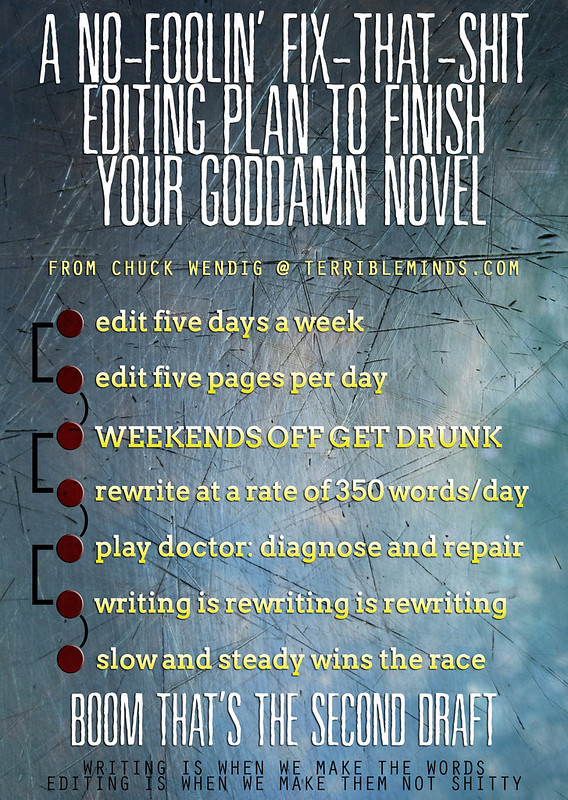
Second, I will point you in the direction of Chuck Wendig's wonderful post on editing so you get it done. (Warning, does contain profanity, but he is genius.) Seriously, read it. It's great advice. And here's his neat info-graphic he says anyone can share:


Okay, now that I've given you someone else's advice, onto mine.

So someone gives you feed back on your book. You don't know this person. They aren't your mom, your second cousin, or your neighbor who runs around outside in his underwear after he's had too much tequila. Their name might be their real one, or it might be their pseudonym, or it could be a screen name like OtakuYaoiShipper20. Either way, they took the time to read your book and your looking for something juicy that can help you fix your work.

Warning! The words critique, criticism, and critic are not negative! Do not have a panic attack upon seeing them in use. It's part of the business.

Here is a list of the kind of people and responses you might get:

The Ego-stroker: This is the most common response you will get. They read your stuff and like it. They'll tell you everything they loved about it. They'll shout it to the heavens and want to have it's babies. Here is the problem, they can't help you with the technical issues or the plot issues or the fact that your hunky hero is unintentionally a giant douche because they're too wrapped up in their own fantasies. They pat you on the head and tell you you've been a good doggie. These people are the reason why a lot of bad fiction gets published. Don't listen to them. Their words are like eating nothing but junk food. It blows you up but doesn't actually do anything for you.

The Troll: They hate everyone. They hate that you breathe. Don't take what they say personally. They will rip on everything without saying anything constructive. They're the opposite of the Ego-stroker. They just want to hurt you.

The Helpful: They come in many different shapes and sizes. How can you tell they aren't the two listed above, they try to point out your mistakes with concrete examples and try to give you suggestions or resources you can use to try and fix them. On the flip-side, they also tell you what you're doing right and why. Or they at least try too. Good criticism is hard to come by. It can be polarizing or keep repeating the same thing. They can sound like an Ego-stroker, or a complete Troll. It is so extremely varied that you will bang your head against the wall trying to figure out who is right. Here is the kicker, it's just their opinion. That's right. Opinion. They might be completely wrong. No one knows your work better than you.

Now that you have your criticism, it's up to you. You have to open to whatever has been said, but you have to take it all with a grain of salt too. If you think your shit don't stink, than you won't be able to absorb any helpful advice. (And you probably wouldn't be reading this.) If you're too open, your brain might fall out and you could end up fixing things that don't need fixed. As a writer, you have to find what will work for your story. Here is some of the things I keep in mind:

How often have certain aspects/parts of your story been referred too? How often have critics told you that your protagonist was too whiney and childish? How many have said they want more background to your world? How many have told you about the Texas sized plot hole in the middle of your story? Keep track. One isn't usually enough, but sometimes it is. If you agree that your dialogue could use a little work, don't be afraid to change it and then run it by more people.

How reputable is the critic? I'm not saying that they need a degree or to work as a writer. (Although, that would awesome). Look at the other critiques they have written and any responses to topics on discussion forums. You can usually tell if someone knows what they're speaking about, or if they have some idea. If they have some of their own stories up, check those out too. See how they respond to criticism of their work.

Be polite. This should go without saying. DO NOT disrespect someone who has taken the time to read your work. It is time consuming. They had other things to do, but they took time out of their day to try and help you. Calling them names, ranting, and raving are not good behavior. It is not professional. Don't like what they say, suck it up and thank them. If you wish clarity on what they said, then ask for it nicely. If you disagree, but they have said something you still want help with, let them know as nice as you can. Arguing doesn't have to be all shouting and screaming. I've seen intelligent debates go down between people with radically different viewpoints that make the rest of the internet look shameful. DO NOT reduce yourself to a YouTube comment.

So where do these helpful people exist. Personally, I'm a big fan of Book Country. The site is filled with intelligent and nice people who just want to help. There is the occasional best seller floating around, and 3 people have been picked up by publishers and agents that I know of. Even though their star ranking system is under scrutiny by their users, they really want to make it useful. Many a member has tried branching out to other writing sites, only to run back. It's one of the few places not ruled by Ego-strokers and Trolls. (We do have the occasional old curmudgeon, but he's harmless and can be quite helpful.)

So, what does this have to do when figuring out when your book is ready to be whored around to agents and publishers like a starving starlet? Here's the problem. You really don't. You can only fix most of the problems before it's clean enough to show off. The best thing I've ever heard was that we never finish art, we only abandon it. There may come a time when all the advice in the world and all your hard work are no longer needed. Sure, there will always be things you have to fix, but you need to limit yourself. You can overwork your writing. Set yourself limits and hope it's enough.

Sorry if the ending was a bit anti-climatic. That's the truth of it. It may take a couple rejection letters to tell you what you need to do. Just don't be lazy. The more you work on it now, the faster it will go. Editing is writing. Not everyone realizes that, but there's the truth for you. Dive into it like you did the words-to-paper part, and it won't take 20 years.

I'm working on a major edit right now that I'm workshopping in a couple of places. I hope after one more run through, it'll be close enough to show off to professionals. Now all I have to do is get my butt in gear and get over the intimidation of pages that look like this:


I never said it was going to be easy.

Thursday, 28 March 2013

Guest Post: Fantasy Author, Toby Neighbors

So you want to please your readers?

Every single one of them?

In the whole wide world? On the world wide web?

Get-out-of-town. 

It's impossible. You will NEVER be able to write something that EVERYONE likes. And if you did then you'd find every other writer out there copying your success. What you need write is something that you would want to read, and then find readers like yourself to take a chance on it.

That's what Toby Neighbors did. I admire him. He chased his dreams of publishing, writing to what publishers and (what he thought) readers would want. But sometimes your story can turn into a square peg trying to squeeze into the round hole of what a publishing house wants. Toby was left clutching at quadrilaterals and a sieve.

When he turned to self publishing, Amazon was on the up-and-up with its ebook sales. Now, after releasing four epic novels in the same series, Toby has recently released a new tome set in the same fantasy world, which in my eyes bookmarks his own personal success story in the world of publishing.

I'd like to introduce you to Toby Neighbours, but I'll let him do the talking!


I want to thank David for the invitation to write a guest post on his blog.  I’m blessed to be a next generation writing success story.  After years of trying to fit into traditional publishing’s incredibly restrictive mold, I’ve found success writing on my own.  I remember having a conversation with my wife about the possibility of keeping the rights to my novels and publishing them digitally.  At the time Amazon was just starting to get traction selling ebooks and the idea of being able to write exactly what I wanted, to package it and promote how I saw fit was very attractive to me.  It took a while to be discovered in the vast world that is the Amazon bookstore, but once I was it changed everything.  In less than a year I was able to start writing full time, move my family across the country to beautiful northern Idaho and really sink my teeth into creating a mythical world large enough and rich enough to be the cornerstone of my literary career.  I have a beautiful wife, three incredible boys, and we are hoping to adopt our first daughter very soon.

I’m a storyteller, it’s not just what I do for a living but who I was created to be.  I love stories and always have, although it took years for me to realize that the resonance I feel with a good story is from a deeper part of me.  I grew up reading and loving great fantasy.  I started with the childhood stuff, like the Ronald Dahl books that really stretched the imagination. I quickly moved on to classic character driven stories like Edgar Rice Burrows’ Tarzan novels and the various Conan novels by authors like Steve Perry and Robert Jordan.

I had a rich childhood, lots of love and plenty of space to let my imagination run wild, but my parents were anxious to see me develop some responsibility in the “real world.”  After high school I went to university where I started dabbling in creative writing.  I took a class just for fun.  I wrote a very short story and remember being almost sick when it was time for the class to review it.  I’ve always been a fast writer and was one of the first in my class to complete the assignment and so most of my peers were silent during the critique, which I was sure meant that they all hated it (actually, they were all terrified of our teacher and the prospect of having their own work dissected before a live audience).  My professor however surprised me by actually liking the story.  It was the first moment when I allowed myself to even consider the possibility that I could write professionally.

Of course it took me over ten years to stop trying to please everyone else with my writing and actually write a story that I liked.  After years of painful (and fruitless) effort trying to write a commercial novel, I returned to the passion of my youth and the kinds of books I still love to read today - fantasy.  My first book Third Prince set the model for my writing process.  I just sort of fell into a system that works for me.

I had written four books before I started Wizard Rising.  I loved discovering magic with my main character and had no idea it would launch my writing career.  My second big challenge as Wizard Rising began to sell was writing a sequel.  I spent a lot of time developing the world of the Five Kingdoms and the deeper I got in this magical land, the more stories I discovered.  So after four very successful novels of the original series, I branched out and wrote the first installment of the Lorik trilogy.

Lorik is the story of man I feel I can relate to.  He’s spent years living his life with no real idea of who he really is.  When that life starts to unravel, he’s forced to face the fact that there could be more to life than he’s ever known.  It’s filled with action and deep relationships that will carry through the trilogy.  Lorik also marks a change in the way I write.  I still start with the end in mind, but with Lorik I let the characters have more freedom and spent time exploring their decisions.  It has a more organic feel that I think is more realistic and relatable to the reader.

The question I’m asked most often is how many books will be in the Five Kingdoms series.  I initially imagined five books, but the story has grown much larger than that.  I have plans for several more books in the original series and at least three more series spawned from the characters and events in the Five Kingdoms series.  I’m living my dreams now, writing full time and teaching my children to chase their dreams.  Everyday I get to play in the world of my imagination and I’m so thankful to all the avid fantasy readers who have accepted me and encouraged me to keep writing.


Everyone knew he was deadly, even in Hassell Point, a city full of outlaws and thieves.  It was obvious at a glance, from his low slung knives, to the blood dripping from his knuckles.   But the stranger wasn't looking for trouble, he wanted a fresh start and Lorik was determined to give him one.

Lorik is a teamster, delivering cargo throughout the kingdom of Ortis from his home deep in the marshlands where he has lived his whole life.  As rumors of magic and dragons in the northern kingdom of Yelsia cause the  King to march to war with his army, lawless men seize the opportunity to take what they can by force.  It could be the perfect time for Lorik to partner with the newcomer named Stone, but the young warrior brings problems of his own that could place Lorik and the people he cares about in even more danger.

Set in the world first introduced in the best selling Five Kingdoms series, the Lorik trilogy introduces new characters who will impact the destiny of this fabled land. Lorik is the story of a man whose world is suddenly turned upside down.  His concern for a friend earns him an enemy, his actions make him a hero, but his honor could cost him his life.

Lorik is Available NOW from Amazon US & UK.

Wednesday, 27 March 2013

Guest Post: Script Writer turned Author, Simon Okill

Sometimes it's not easy being an author. Starting out, as with everything else, is the hardest part for many. Knock backs are to be expected, but unless you can roll with the punches you'll never make it to the second round let alone the second chapter of your story.

One such author that experienced his fair share of hurdles in Simon Okill. But through hard work, true grit and determination, he has come out swinging and is now the proud author of the adult humour/paranormal romance novel 'Nobody Loves a Bigfoot Like a Bigfoot Babe'.

Guest Post:

I live with my wife, Shirlee Anne and our cat, in a pretty coastal town in South Wales, UK. We both love Stephen King and had read many of his books and enjoyed their transition to the screen. Due to our love of books, my wife and I dabbled in writing for some years as a hobby. We were approached by a film company to write a paranormal TV series. We struggled most nights and all through weekends to come up with 22 episodes only for the company to go bust. Then after a serious accident at work, I was forced into early retirement due to disability. I used my newfound skills as a writer to help with my depression. We decided to use our TV series episodes as templates for film scripts and novels. My writing became more serious as certain A-list actors expressed interest in my scripts and my debut novel Nobody Loves a Bigfoot Like a Bigfoot Babe was accepted by Christopher Matthews Publishing after so many British publishers turned it down. More Bigfoot to come.


The Northern California town of Big Beaver has become a haven for Bigfoot, alien sightings and is home to The Phantom Bigfoot Bather. One particularly weird Beaverite, Duane, has kept the Bigfoot a secret, but to his utter dismay, a female Bigfoot abducts a teenager. Duane must use all his guile to stop his secret from getting out, especially now that MB, his close friend and crypto-zoologist, is on the trail, along with Sheriff Lou and the FBI. Can Duane keep his Bigfoot friends a secret? And what does MB discover deep in the forest?

Review:

Nobody Loves a Bigfoot Like a Bigfoot Babe by Simon Okill is a part comedy, part mystery, part who done it novel, that despite laughing at the title, I really enjoyed. I found that once I got into the book I could not put it down. The author did a great job in developing a story that at times seemed a little bizarre, yet at those time I would literally breakout laughing. The storyline was well developed and easy to follow. There were plenty of twist and unexpected turns which kept you glued to the story. I like each of the characters in the story. Simon Okill did a great job in building each character and making them easy to identify with. The characters were down to earth and believable. 
I enjoyed Nobody Loves a Bigfoot Like a Bigfoot Babe by Simon Okill and recommend it to adult readers (due to mild sexual content). Read it and have a good laugh.

'Nobody Loves a Bigfoot Like a Bigfoot Babe' is available from Amazon US & UK in both electronic and printed formats.


Tuesday, 19 March 2013

Guest Post: Fantasy Author, Kyra Dune

Today I'm going to feature another Indie fantasy author Kyra Dune. She's already got a string of novels out on the digital bookshelves, but I thought I'd invite her along to talk about her newest release 'Flight of Dragons', a Young Adult Dystopian fantasy.


Micayta’s world has long been gripped in the thrall of an endless winter that grows worse with the passing of time. Life is a constant struggle. Then catastrophe strikes the small town in which she lives, thrusting Micayta and her brother Pytaki alone into the snow laden countryside. To keep herself and her brother alive will take all the strength that she has.

Then a mysterious stranger appears to complicate matters. Tech has an amazing story to tell, but is any of it true? Old wounds and betrayals make Micayta slow to trust, but without Tech she and her brotherwill never make it across the countryside alive. Through bandits, wolves, and snowstorms, the three struggle their way to the city of Phadra. But the real danger lies within the city walls, where Micayta becomes a player in a deadly game with a dark-eyed mage. Nothing is what it seems.

As the truth unravels, Micayta finds herself drawn into a struggle much bigger than she ever dreamed. Choices must be made and sides taken. But the question of who to trust is one not easily answered. Micayta will have to open her heart and find a way to let someone else in, or the flames that destroyed her home will consume the world.

Kyra Dune was born in Oklahoma, but spent most of her life travelling with her family. She is the author of several novels, including: ‘Flight of Dragons’, ‘Elfblood’, and ‘Shadow Born’. As a little girl, her favorite books were those that told of ordinary children who traveled to magical worlds. She’s yet to find her own magic wardrobe or rabbit hole, but she hasn’t given up the search. You never know what might be waiting over the next rainbow. 

Sunday, 17 March 2013

Guest Post: Fantasy Author, Petteri Hannila

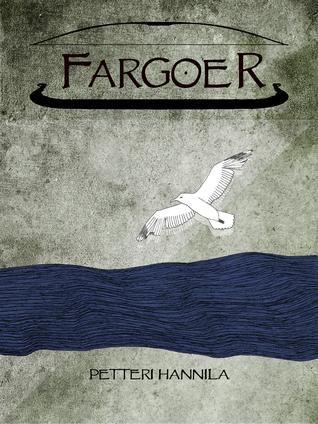
Apologies for the delay in service dear readers! I've had myself a little time away 'in the sun', but normal viewing will resume.....now? I'm still unpacking/dusting off from the trip, so with little time to spin a yarn of my own, I'd like to take this opportunity to introduce you to another author friend of mine, Petteri Hannila from across the pond in Finland (check me out getting all global/European and the like). His acclaimed stories, known as 'Fargoer', have gained a lot of attention here on the interwebz so I thought it was about time we learn a little more about the 'man behind the pen'.


I'm a writer from Central Finland, a software designer by day and a dad/husband/dreamer/martial artist by night.
It all began when I was eight years old. I found out that there were books of Tarzan, my childhood hero. My mother started to read them to me, but censored them - all of you who have read them know why. Annoyed by this, I started to read them on my own. Dreams and legends have followed me from those days, as companions on my voyage through life.
Only few years after that I thought about writing for the first time, but for a long time I pushed it away from my mind for supposedly more important things. Finally I understood that none of my stories would ever see the daylight until I got started, and I did. From the days of Tarzan, exciting adventures and fantasy stories set in the past and the future have been my interest. Thus, the natural choice for me was to start writing science fiction and fantasy. Some years ago the idea of Fargoer made its way into my consciousness, and it hasn't loosened its grip of me since.
New Fargoer stories and paths of Vierra's future circle in my thoughts until I write them out. There are so many stories to tell until the end, and that end is painted clearly on my mind.
I believe Fargoer can bring a breath of fresh air to the fantasy genre, featuring a powerful historical background (the genre is historical fantasy) and storyline combined with a strong female protagonist. The book was released in Finland earlier this year, and the feedback has been promising and encouraging. Here in Finland, me and my brother Miika are pioneers in self-publishing, since the field is completely dominated by traditional publishing houses and large companies. Besides hoping to offer people an enjoyable and immersive read, we hope that Fargoer would clear the way for other independent, quality releases from Finland. We also believe Fargoer would be an exotic read for many, since our country is so far away and quite unknown to most of the world.


Fargoer is available from:

Amazon
B&N


Monday, 4 March 2013

Guest Post: Fantasy Author, David A. Lindsay


I'm all about supporting the new, the fresh, the upcoming. So when David A. Lindsay announced the publication of his newest 'Gaspar The Thief' story, I couldn't resist getting in contact with him. I've seen his name crop up around Goodreads, Twitter, and Facebook, and it's likely that you have, too. So, without further ado, I'd like to introduce the man behind it all!


The back story to 'Gaspar The Thief' may be a little different to many other current e-book releases in that it was actually written in the 1980s, when I was in my twenties.

I had previously succeeded in having a few short stories published in arts magazines in the mid to late 1970s, a couple of them commercially. Thereafter, I wrote 'Gaspar The Thief' in fits and starts, with long gaps in between, over a period of around ten years, but I never did anything with it, and did not make even one submission to a publisher. Looking back now, I think there were two reasons for this. Firstly, I got married, had three children, and was very busy as a young court lawyer building a career. Secondly, and this was perhaps the main obstacle, I think I was too much of a perfectionist.

This all changed in early 2012 when my wife bought me a Kindle, and I realised that this offered a new opportunity to share what I had written. Fortunately I had taken steps over the years to preserve the original word-processed files. However, these had been created on an old Amstrad green-screen 8256 (does anyone else remember these?). Fortunately, I had at one point had the files transferred to floppy disks. I still had to buy an external floppy drive to access these, of course, but I was much relieved to discover that they were still intact. That's when I sat down to read what I had written almost thirty years ago. This meant that I was able to read 'Gaspar The Thief' almost totally afresh. I had actually forgotten large parts of it. And that's when I discovered that it was much better than I had thought when I wrote it. I am still a perfectionist, but I was very pleasantly surprised by the standard of writing. Moreover, I did not think it had dated at all. Nevertheless, I still revised it twice from beginning to end and re-wrote a few parts before publication.

Another aspect that some may find interesting is that it was not influenced at all by Sir Terry Prachett's Discworld novels. A few reviews have commented favourably on similarities to Sir Terry Pratchett's work, but the truth is that I only started to read his books much later, in the 1990s, long after my book had been stored on disks and consigned to the attic.

The floppy disks produced more than just 'Gaspar The Thief'. While examining them, I discovered long forgotten fragments of unfinished stories. One of these provided the plot and a good 10,000 words of 'Gaspar And The Fantastical Hats', which has now been completed and published as a prequel novella. I also found another lengthy fragment that will form the start of the next novel.

'Gaspar And The Thief' is available in paperback from Amazon. It is available as an e-book from Amazon, Apple, Barnes and Noble, Kobo, Smashwords, Sony Reader, and others. The prequel, 'Gaspar And The Fantastical Hats', is currently available only as an e-book from Amazon, but will be available for other e-readers in due course. However, it has been added to the current edition of the paperback.

Finally, here's a little personal background. I was born and brought up in Dundee, Scotland, but have lived in North East Fife, near St Andrews, for nearly 30 years now. I am married with three children, all of whom have now left home. I was a lawyer for 20 years, but for the last 13 years have owned and run a web design business in the UK.

Monday, 18 February 2013

Guest Post: Sci-fi Author, Doug Strider.

Writing and publishing is not the dog eat dog world you'd think it is. Indie or indie, e-published or paperbound, genre or otherwise, for the most part the 'writing' community stick together - a pack, almost. We have our alphas, our betas, cubs and sires. A pack sticks together, and that's what this post is about.

At present, I have only published fantasy stories, but my second love is Sci-Fi. I stumbled across a Sci-Fi author by chance the other day, and found my god can he spin a good yarn! So without further ado, I'd like to introduce you to Doug Strider.


Hello, I’m Doug Strider.

There is a part of me that remains 7 years old. The part that absolutely loves sci-fi. Watching spaceships, ray guns, aliens, heroes fighting the good fight on cinema screens and the humble old television. My dad and I engrossed in everything that was going on. Very fond memories right there, sci-fi was something we both shared a love of.

That same 7 year-old also had a fantastic imagination. He was a space captain, he had a nemesis (Ruston, I’ll let you guess what his speciality was), he had a spaceship (rather reminiscent of Thunderbird 2 it turned out) and he was a goddam space hero. That was my first proper creation I believe. I don’t think building vast spaceships from Lego, that constantly fell apart every time I tried to woosh them through the air, counts as much but it was bloody good fun.

Thirteen years later the 7 year-old piped up in my brain and I started writing properly. I wrote a sci-fi novel and the start of many more but that all faded away as my attention was needed elsewhere and it would take around twenty years for the voice to say, “Hey, remember when you were a space captain? That was great.”
Surrounded now by many creative people, especially my writerly partner Jen, I felt comfortable to pursue story telling once more and the 7 year-old me is very happy indeed. So that’s how I came to start writing Space Danger! It has spaceships, ray guns, aliens, heroes fighting the good fight and it’s fantastic fun. I’m loving immersing myself in this universe, it’s giving me a chance to express my imagination, my humour and that there’s life in this tired old brain yet.

Surrounding my rekindled love of writing, I’m still involved a fair few audio projects, another awesome outlet for my creativity. The Bearcast (co-hosting in character), Soldiers of Tangent (co-hosting as myself in an ever expanding spiral of tangents and Grade A fibbing), Dark Fiction Magazine (narrating, herding narrators and producing) and the odd contribution to other projects here and there.

The 7 year-old loves it all but is mostly excited that he gets to be a space captain again. That’s the best bit.
This blog post is brought to you with thanks to D.E.M. Emrys who has let me guest on his site. He writes a cracking tale himself. Currently reading It Began With Ashes in my other genre of choice and I’m really bloody enjoying it.


D. E. M. Emrys. Author. Soldier by day, Soldier by night - Writer in Between. 

Author of Heroic Fantasies:
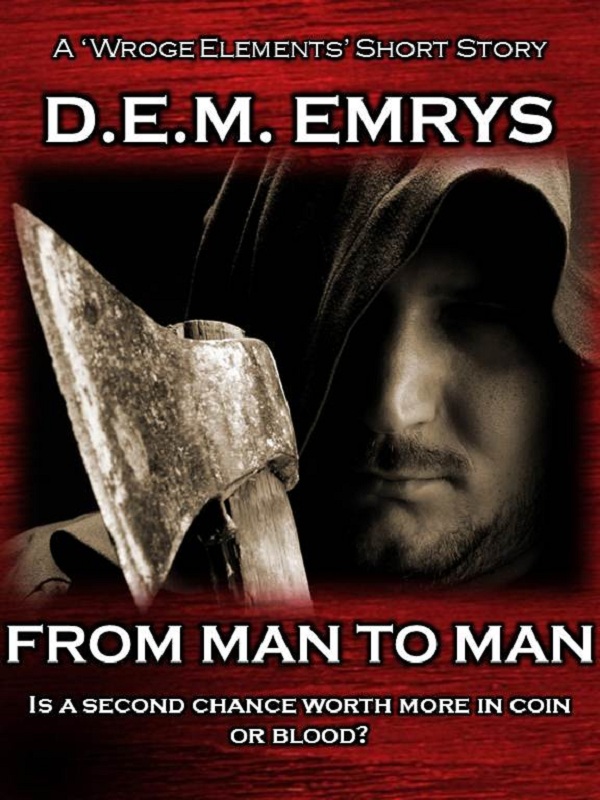
From Man to Man - Currently FREE from Amazon.
Amazon UK


It Began With Ashes.
Amazon US

Sunday, 17 February 2013

Can There Be TOO MUCH Fantasy?

EDIT: Update as of 20:20hrs (GMT) 17/02/2013 - after feedback, I've only just noticed that the original fantasy authors featured here were all male. This post has been updated to include females. Upon scanning my book shelf, I realised that many of the stories I own are written by male authors. The original observations were in no way meant to intentionally dis-include the female authors of the fantasy genre.

Is the fantasy world over-populated? It’s a valid question and one that keeps raising its ugly head in the current era of ‘Lord of the Authors: The Fellowship of the Fantasy’.

Without battling out the topic of Indie vs Traditional, I want to take a moment and talk about fantasy worlds. A simple blog post can’t cover every single fantasy tome to have ever graced a book shelf (or a digital market place like Amazon, for all you e-publishing gurus), but we can highlight a few.

J.R.R. Tolkien with his elves, and his dwarves, his hobbits with their hairy feet, and his trolls. Ringwraiths, a dark lord, and a powerful artefact that is a curse to all those who bear it.

George R.R. Martin with his thrones, and his games, the squabbles of men, and the treachery, futility and thick-fast plots (oh, and if you’ve watched the tv adaptation, there’s a fair share of boobage, too).

Peter V Brett – demons galore! How ‘man’ (and woman!) can overcome their fears for what they believe is right.

Mark Lawrence explores the moral depravity of a Prince who won’t let anything – or anyone – stand in his way, even if that involves burning the world just to keep warm.

Michael J Sullivan brings bromance to the fold (Webster’s unofficial definition of bromance: bro-mance, a combination of brother and romance, meaning ‘a brotherly romance’ between two males. Often seen sharing large quantities of bruises, beauties, and beatings) with a healthy dose of death-defying escapades and swashbuckling adventures.

John Gwynne breaths fresh life into the folklore and legend side of fantasy, giving Giants, Wyrms and even Angels a gritty new lease with a Nordic/Celtic feel.


Brent Weeks forefronts assassins in one, and mages in another, but above all else they struggle with their own powers for further means.

Brandon Sanderson…magic, need I say more? But then again, his world-building is second to none.

Joe Abercrombie touts more knives than any sane man should ever need, but lucky for us not all of his characters can be deemed sane enough to count or care for that matter. But when all is said and done, it’s down to being what you’re meant to be, and (as he often states by way of infamous barbarian Logen NineFingers) once you've got a task to do, it's better to do it than live with the fear of it.

Ursula K Le Guin, if there was a Big Momma of fantasy, UKLG would be her. Her stories are folklore brought to life, magic and mysticism intoned with a rich world building.

Karen Miller strives to break down the old fantasy cliches, using them where she will, but bending and twisting them into something new, pushing 'fantasy' into a more 'fantastical' realm.

Robin Hobb, who's back catalogue boasts more tomes than the knives of Joe Abercrombie's cast - claimed by Orson Scott Card to have 'set the standard for the most serious fantasy novel'.

Helen Lowe, a newcomer to the fold, but with her fresh blood added to the mix the 2012 Gemmell Award winner (Morningstar category) weighs in with a hefty dose of darker, grittier fantasy and a deeper meaning of how we treat each other.

I’ve barely even touched the surface here. I could go on for hours. James Barclay, David Gemmell (big daddy of British heroic-fantasy), Robert E Howard, Patrick Rothfuss, Robert Jordan, Tamora Pierce, David Dalglish, Mazarkis Williams, Moses Sirergar III, Ben Galley, Steven Erikson, Christopher Paolini…ok, ok – I’ll stop.

So, fantasy is a busy world(s). But each and every one of them is different. Yes, a lot of them share themes or creatures (elves, dragons, hobbits, dwarves, damsels in distress…hobbits, or other creatures with hairy feet?), but would you really say: ‘No more’! Heck, I’m sure if you asked a lot of these authors they’d admit to being inspired by one another. Of course they would.

Ok, let’s imagine if someone said ‘No more’ to Robert Jordan. Would we have the Peter V Brett’s, and Christopher Paolini’s of today? ‘Put that pen down’ David Gemmell…and voila, no John Gwynne’s or James Barclay. How many would we lose if Robert E. Howard had run out of ink on the first page, and Conan had been lost to an unfinished sentence?

IMAGINE THE CHAOS if someone told J.R.R. Tolkien to shave his hobbit and write a romcom. Think of the children, pray for their futures!

Publishing is an ever changing industry, and fantasy is an ever changing realm of possibilities. If you’re Indie or Traditional, reader or writer…could you really say NO to one last fantasy? And before you start culling dwarves, shaving hobbit feet, or cashing in dragon fangs for the last copy of ’50 Shades of Grey’ from Amazon…just remember:

A Fantasy author isn’t just for Christmas. They’re for life.

(And even then, they’ll think of a way to come back and haunt you from the afterlife – they’re fantasy authors after all).

D. E. M. Emrys. Author. Soldier by day, Soldier by night - Writer in Between. 

Author of Heroic Fantasies:
From Man to Man - Currently FREE from Amazon.
Amazon UK


It Began With Ashes.
Amazon US

Tuesday, 29 January 2013

Creative Writing 101: The Importance of Setting Goals


Just a little something that I'd like to share with you all. This was brought to my attention by Allison Morris, who created this graphic which illustrates the benefits of goal setting and why, in light of the New Year, it’s important to commit to our goals.


Originally hosted on the Online Education Database blog.

Tuesday, 30 October 2012

Creative Writing 101: Critique aka Swallowing Fire.


    Be it a pat on the back or a 'smack upside your head', critique can leave you shell-shocked. Ah, critique, critical thinking and delivery of a response warranted by the impact of a subject's work. Layman's terms: opinion and advice on how to take your work to the next level, in the critique's opinion.

     Now, good critique is different for everyone. Some people need an extra spoon full of sugar with their review-brew, whilst others don't mind having their work torn to shreds for the sake of improvement. 'Good critique' has to be tailored to an individual, but seeing as I can't tell you how to submit or receive critique for each writer/artist, I'm going to give you a broad brush approach that won't get you hung, drawn and quartered.

How to Give Good Critique:

     Hope. Give a writer hope that there is promise in their work. No matter how had a piece is, it has potential. But, if you trash the creator and rip them a proverbial 'new one', how are they going to realise their hopes and dreams?

     Hope:
Honest – don't sugar coat everything, but don't poison a perfectly good mouthful. Be honest, be fair.
Opinion – remember, the work you are critiquing has stemmed from an idea, and opinions clash. What might be right for you might not be right for everyone.
Purpose – give your review direction. Either critique chronologically (start to finish) or by means of headings (characters, technique, plot etc.). Make sure its constructive yet critical - that's the purpose of critique after all, right?
Evaluation – have you weighed up the goods and the bads at the end? Not everything is bad, point out the strengths, consider the weaknesses.

     Bad critique is horrible. It's when someone smashes a writer to smithereens just for the sake of it. Yes, some may want to watch the world burn, but be fair…only go so far as to push them onto hot coals and make them dance for their money's worth! Good critique will give a writer the helping hand to the next stage. Don't forget: one man's story is another's life. What you say might directly offend or upset someone.

How to Accept Critique…Good?

     Thank your critiquer. Sounds odd trying to tell someone how to accept critique. But, you'd be surprised how many writers and artists react poorly to critique. Yes, it can be hard when you've got a rabid pit bull of a reviewer gnawing at the very bones of your greatest masterpiece (TO DATE!), but shaking it off is only to making the bleed worse. Don't be a sore loser if you're shortfalls are laid bare to you. But, then again, don't be a sore winner if you're heaped with praise! 

     Thank:
Timeliness – look, think of it this way: there are thousands of stories/pieces out there and someone took the time to discover, inspect and review yours. The least you can do is offer them a timely response…not three months down the line when they've moved on.
Humility – you're not god's gift to life, the Adonis of art, the Perseus of poetry, and so on. Take praise in your stride, as you would critique. Don't let it go to your head, as you'll take a fall when someone rips the carpet out from underneath you, and it'll hurt all the more with a swollen brainbox!
Acceptance – you're not the greatest for everyone. You never will be. You CAN NOT please everyone. So when someone points out a fault, or something that they don't like…fix it or move on.
Never argue back – if someone has ruined you in a critique, thank them and move on. Don't argue. You're lowering yourself to their level, and you're about to upset them (and possibly others) as much as they have upset you.
Know when to change – Sure, spelling mistakes and grammar need to be dealt with, but if it's a question of style…ask yourself, do you want to change your work to please someone else, or would you rather keep doing what you enjoy?

     Wow, now don't I feel like some sort of agony aunt? I hope that this has been an eye opener, and you'll keep my points in mind when you next turn to receiving or submitting critique. Remember, we're all part of a wider community, an artist community, and we don't just have an audience, we have peers!

     Anyhow, I'm off to go sharpen a few wooden stakes and dig a few holes, before any of you miscreants come charging over to give me a piece of your mind!

Wednesday, 24 October 2012

Creative Writing 101: Tools of the Trade aka Rome wasn't built in a day!


     Rome wasn’t built in a day. Heck, it would’ve have been built at all without the rights tools and materials. Minus the stone, wood, manpower and hammers, what would have been made? A rough circle in the dirt?

     Writing is very much the same. You’re going to need plot lines, characters, scenes, landscapes, etc. etc. But today’s journal is going back to the foundation of writing. Imagine settling down to write…you pick up your pen – it’s run out of ink. You fetch a new pen, but the clicker is broken on this one. Fine, settle for a pencil, but there’s no paper and the lead is broken anyway. You’re reduced to scratching chalk on slate until it rains and washes away your epic, bestselling, genre-breaking novel.

     Take your seats class. Today we’re going back to basics. We’re going to discuss what a writer needs in this day and age to craft his/her masterpiece. Now, you might have differing opinions to mine here, and please feel free to share them below, but this is more of an ‘ingredients list’ for the writer, rather than the story.

     Firstly, you’re going to need a way of ‘rough writing’. This to me is first drafting, word-for-word, raw and unedited story-goodness. I prefer to write this in a notebook as I like the feel of paper and pen, but feel free to use whatever you life. Some write straight onto PC/Laptop, others use sheets of paper – whatever your fancy!

     I’ve just mentioned the old pc/laptop – and you’re going to need it. With it, you’ll need a good word processing program (MS word being the most popular). It may seem like I’m teaching you to suck eggs here, but, it’ll spot typos for you, and it’s a MUST for ease of editing. Try to type up your work as often and as soon as possible, as hard copies (stuff written in notepads) have a habit of getting lost, damaged, or in my case used as kindling when out on exercise with the Army.

     Now, you’ve got the materials to record your story, but what about the little ideas that pop up here and there? I carry a small notebook on me at all times. AND if all else fails? I use my phone. The iPhone has a handy ‘Notepad’ app that I populate with more story ideas than contacts in my phone. Back in the day, when all I had was one of those trusty Nokia’s that would’ve sustained a gunshot, I was known to text myself to save ideas for later.

     Right, it’s all falling into place! You’ve got hard and soft copies of your work, and a collection of notebooks strewn about the place to keep your writing going. Last, but definitely not least, you’re going to need a BACK UP! HUGELY important. I have several, and I implore you to do the same.

     Personally, for my backups I have: multiple folder structures on my laptop, emailed documents on several accounts, and a ‘Cloud’ (online storage – a must have). I also have a USB, which may not be all that reliable because I leave it in my pocket at all times (and it’s not as if I have a regular office job), but I do plan to invest in an external Hard Drive to keep the rest of the digitals safe. As with copying up from rough to good, your backups should be kept up to date.

     Other things that are useful to have to hand:
A pen…ok, I’ll take this more seriously!
Sketch paper – I find drawing diagrams helps me picture certain scenes, or the layout of a room.
Squared paper – for maps (oh, and for playing noughts and crosses with whoever’s about).
Music – for me it helps get the creative mindset in gear.
Internet connection – don’t let it distract you, but this is crucial for research.

     There we go. Very billy basics, but I thought this would be a fitting return to my ‘Creative Writing 101’ journal entries after a short break. If you have anything to add to this list, feel free to do so below in the comments section. Thank you all for stopping by, and next week we’ll continue as per usual.

Tuesday, 16 October 2012

Ebook Debut & Exclusive Sneak Preview!


     A big thank you to you all. Yesterday 'From Man to Man' went live on both Smashwords and Amazon. I couldn't have done it without you - readers, watchers, followers and friends. Your support and advice has helped me to this stage, and I'm glad to boast myself as a Self Published Author. I hope you've enjoyed my stories thus far, and I can promise to do my utmost not to disappoint from here on in. As a big thank you, I've included the first chapter from 'It Began With Ashes' as a SNEAK PREVIEW in the ebook.

If you're able to, I ask you to support me one last time by downloading 'From Man to Man' on Smashwords and Amazon, and leaving an honest review.

Wednesday, 3 October 2012

Character Creation 101: The Fleshy Bits aka Quit Peeking!


     It was his upbringing…you can’t blame a boy after he was raised like that. But one does not simply walk into Mordor. You’d have to pay a fair penny for that to happen. Maybe that’s why he did it. For the money. Plenty o’ them celebrity-peoples do it for the money. What about Tinkers, tailors, soldiers and spies? Though, wasn’t it Colonel Mustard in the dining room with the candlestick? Don’t get me started on candles!

     Though the above sounds like the ramblings of a madman…ok, I’m not even going to try and defend it. It is what it is. HOWEVER, the point I’m trying to get across is the thought process going into creating a character. So you’ve got the name and you’ve got your tags from my last two blog posts, but now it’s time to breathe life into your characters.

     Let’s start from the top.

     History – the upbringing, the old, the new, the current. Everything that happens to a person shapes them in one way or another. This isn’t so much as their ‘destined path’ in life, but more their mood, attitude, likes and dislikes. Take the stereotypical ‘raised by wolves’ character. They grow up to be a little wild, rough around the edges, sometimes a bit of a loner. This fits with the upbringing. Now, if said characters was raised by wolves BUT was a debonair fop, blue-eyed, baby-faced, and able to use every utensil at the kitchen table whilst being able to concentrate long enough to eat with his mouth closed…then either the wolves were well versed in mealtime etiquette or there is another side to his history that we do not know. Sometimes it’s not necessary to explore the entirety of a character’s back story, but we were all young once.

     Motivations – what’s made the character act as they do? Not so much as in history, but why are they currently involved. Queen and country? Money? Fame? To get the girl/guy/Colonel Mustard? Revenge? A motivation can be anything, but it’s something that helps the reader connect to that character, and to relate to them. It turns a character into a being, a person. Take Luke Skywalker for example. He wanted revenge, peace, and a new haircut amongst other things.

     Methods – Everyone has their own methods. How they think, how they act. Most importantly, how do they REACT? Problem engagement and solution is critical to a story. I mean, that’s what a story is. A problem, and an account of how it is overcome (or not in some cases). Your character needs a clear-cut method of copy with things. This could be from having a berserker-like rage that sees them through the bloodiest of battles, to a severe arachnophobia handled only by the trance state of believing themselves to be a rolled-up newspaper. Put simply, your character is a priest. How do they respond to being attacked? Turn the other cheek (not literally…well…), preach the wrongs of their attackers’ actions, beseech mercy? Who knows, your priest could be a Warrior-Monk who beats 50-shades-of-whoop-ass into any who dares raise a hand to them.

     Functions – your character….do they have a function? Are they important to the story? Or have you just made them up for the heck of it? If they serve no function…chop them. It’s fine to have a background characters, or someone who acts as a plot device, but if your guy/gal is only there as eye-candy why not tie that role into someone else? That way you’ll have One more fleshed-out character rather than two sacks of bone and gristle.

     Purposes – what does your character want in life? Tied closely to Motivations, a Purpose is the long or current goals for that character. Save the world in time for tea? Go to the shops before they’re old? Giving a character a goal helps share a sense of achievement with the reader. I mean, we’re all going somewhere, right?...hello?

     Opinions – everyone has a right to their own opinion, and no opinion is ever wrong. This to an author is like handing a kid a box of matches and telling them to go play in the hay barn. Your character can have an opinion on anything, and their actions will be shaped thus. Look at Spiderman. ‘With Great Power comes Great Responsibility.’ Now, look at the Oracle in the Matrix Reloaded. ‘What do all men with power want? More power.’ CONFLICT = ACTION. ACTION = DRAMA. DRAMA = SUSPENSE. SUSPENSE = CLIFF HANGERS. CLIFF HANGERS = MORE BOOKS. MORE BOOKS = ….repetitive stress injury.

     After looking into the above, ensure that your characters are consistent in their ‘lives’, and develop how the world shapes them. External and internal factors make us the people that we are, and that goes the same for your fictional friends. Make them different, don’t be afraid to set them aside from the pack. Give them depth, a reason for existence, connectivity.

     And if all else, fails…I know a girl in a red hood who’s grandmother can school anyone in table-side manners.

D. E. M. Emrys. Author. Soldier by day, Soldier by night - Writer in Between. 
Author of Heroic Fantasies:

From Man to Man - Currently FREE from Amazon