Wednesday, 14 May 2014

Author Inteview: Antoine Rouaud - 'The Path of Anger'

As part of the on-going series of posts covering the David Gemmell Legend Awards, I invited Morningstar nominee Antoine Rouaud to talk about his debut 'The Path of Anger', published by Gollancz in the UK. 'The Path of Anger' isn't just one of the hottest releases in the UK, it's everywhere, with simultaneous releases in France, Germany, Holland and Spain!

Please note: English is not Antoine's first language, and my French is limited to 'Where are the pants? Oh, the pants are in the church' (a story for another time), so between us we have managed to conduct the interview to best fit. Whilst some of the wording may have been edited for clarity, the answers remain the same. I took the explicit decision not to change the wording so as to preserve Antoine's character and charm.

 
Hi Antoine, welcome to WWaS (Written With a Sword). Congratulations for being nominated to the shortlist in the David Gemmell Morningstar Award. For those readers who have yet to ‘meet you’, tell us a little about yourself.

Thank you very much, it's really a great thing for me to be nominated in such a prize as the David Gemmell Morningstar Award. It's really incredible and i'm really honored. So, who am I ? Just a little guy from Nantes, in the west of France, a nice place to live - and the birth place of Jules Vernes! I grew up with his universe, and with the story of my city, too. Its history is hard and dark with slavery during the 18th Century, but also bright and clever with a lot of artists, and a good part of "surréalisme". 

I have always written – and since I’ve been able to I’ve created stories. I worked in radio for a while, and realized audiostories which are still available on internet. Now, I'm still living in Nantes, and working hard on the second book of ‘The Book and the Sword’. 

 
So, how did you go from being in the world of radio to writing? Have you always wanted to be a writer?

Yes, indeed. It was my dream... as I dreamed about being an actor, writing stories for cinema, composer... As I said above, I have always written – different things, different stories. I took my chance when I met Stéphane Marsan from Bragelonne. I spoke to him and proposed to him my book. What happened next was just unbelievable. 


What does it feel like to have your debut novel simultaneously released on an international level, in multiple languages?

Nothing Special... maybe a strange sensation of explode myself. Seriously, the good word to explain what it feel like is unbelievable... again.  

 
Tell us about ‘The Path of Anger’ – what’s your ‘elevator pitch’?

It's a strong relation between a man who wanted to be a dad, and a boy who want to be the greatest knight in the world. It's a story of both, with their different ways of thinking, one from an ancient world, the other ready to build a new one. It talks about what we can learn from each other, and what we need for grow up. 

And, not forgetting, there’s a dragon, and it’s set during a dark period when a revolution tries to bring hope to the common people. 
 

How long did it take to plan and write ‘Path of Anger’? Do you have a writing routine?

No writing routine really. I just wanted to make the best I could. It takes me... let me think... six month for writing all ? Maybe a little more but not so much. 

 
What inspired you to write ‘Path of Anger’?
 
Especially tragedies. From Shakespeare to Corneille... And Greek tragedies. I wanted an epic story. And tragic too but not for free. I tried to write it with a meaning, some way to think about our lives. It's why the base of the Trilogy is built on a book which is contain the destiny of all mankind. 

 
Now that ‘Path of Anger’ has been released into the wild, are you happy with it? Anything you’d change? Have you changed from the process?

 More coffee. More stress sometimes... but more confident too. I'm really happy. Now, I have to work more and more for write the sequel! 

 
What was the hardest part of writing ‘Path of Anger’?

Corrections. The corrections with my publisher. Because you have to doubt about your script. You have to put your ego aside. You have to understand all the critic are made for the better of your story. Then, you have to write again, correct what it seems wrong. That was the hardest part. Finally, the biggest part. 
 

The story follows two major characters, that of Dun-Cadal the knight, and Frog the boy from the saltmarsh. Which is your favourite?

 I love both ! No one is black or white. They both have their weaknesses and  strengths of mind.  Which is important for a story I think. Having characters who want to love and hate. 

 
Are you the mentor, like Dun-Cadal, or the apprentice, like Frog?

I think I am more closer to Frog. With more anger. I was like him when I was a teenager. Without a sword, special power and the desire to kill everybody of course. 

 
What would you like readers to take away from ‘The Path of Anger’?

I want the readers turn the last page of my book and think about what they just read... what happened to the characters, why they choose what they choose... And think they had a really great time. 


What does it mean to you being nominated for the David Gemmell Morningstar award?

It means a lot. It's really an honour. My first book ? Released in all those countries and nominated ? ... amazing. I'm proud of it, I try to live that. But I have to think about the next step, the most important step. Make a good, very good, second book. For those who trust me, those who loved the first one. I have to try my best. 

 
David Gemmell is regarded as the ‘big daddy’ of modern British heroic-fantasy. Who is your hero?

I don't think I have one. I like so many authors, I learn about them. No-one especially is my hero. Or, all of them are. 

 
What can we expect next from you?

To finish the Trilogy and make it a great one? The Path of Anger is my first novel. I can do more. I want to make the sequels good enough, even better.  

 
Do you read other books in your own genre? Who is your favourite author?

I had to read some books recently. I was curious and didn't know so much about this genre in fact. So, I read Pierre Pevel, Scott Lynch, Mark Lawrence and enjoyed it. Especially ‘The Lies of Locke Lamora’ which is a great moment of adventure. 

 
Do you have any pearls of wisdom that you’d like to share with would-be writers?

Just write. Write, write, continue to write. What you want, when you want. Try to be your own critic first and then, when you will seems ready, go. Even you don't succeed with a story, the next one maybe will be the good one. Writing is not a question of skill. It's a question of will. 

Tuesday, 13 May 2014

Guest Post: 'The Villain's Point of View' by Mark T Barnes


Where would the hero be without their villain? The protagonist, without the antagonist? The conflict between two forces, whether directly or indirectly, openly or secretly, has been a staple of storytelling. Hero and the villain don’t always start as such, nor do they always end up as such, but at some point in both character’s journeys they will oppose each other in one way or another. Readers should have as strong a reaction to the villain as they do to the hero, and like the hero the villain should develop over the course of the story, reactive to their changing situation, and with the intention of being victorious.

The antagonist serves many purposes. At their core they are the foil to the protagonist, set at odds by contrasted values, goals and outcomes. Villains and heroes execute different plot roles: often it is the villain who develops the origin of the conflict, while the hero provides the solution, or vice versa. A villain does not need to be evil to be effective, but like the hero they should believe strongly in what they do. In some cases the difference between a villain and a hero is purely a matter of perspective, motivation, and means to achieve what are similar ends. Antagonists can teach us as much about our nature than a hero, relieved as they can be of social restraint and the pressure to do right. Villains often do what we wish we could do, were it not for the consequences.

To me the best villains are those who have clear motivations, are consistent in the pursuit of those motivations, and can generate a level of understanding in the reader. Making the antagonist sympathetic in some way is also a useful tool so that readers engage with the villain whether they want to or not. A good antagonist can make an excellent point of view character, providing a 360 degree view of the story as well as a different lens through which we can examine the protagonist’s actions and motivations.

In the Echoes of Empire series there are a number of villains but the most prominent is Corajidin of the Great House of Erebus: a nobleman and a statesman; a nationalist and to a degree an idealist; intelligent; educated; and with firm opinions, a course of action, and the will to see it done. In the early days of writing The Garden of Stones, the first novel in the EoE series, Corajidin was never a point of view character. It wasn’t until first readers had read Act I that they saw some value in telling a third of the story from the perspective of the man who set events in motion. So in addition to the points of view of Indris and Mari, I added Corajidin and additional avenues of telling the story opened up. Rather than hearsay and conjecture, the reader had the direct perspective of the villain and knew not only what Corajidin wanted to achieve, but why.

Corajidin begins the story as tragically flawed and misguided, but his motivations are clear and his methodology understood. As the story unfolds either his expectations for his own future need to be managed, or his course changed. To satisfy a self-serving agenda within a veneer of national pride and sentiment, what little decency remained to him was shredded away as he dug deeper into his id and ego to do what he believed needed to be done. As a point of view character the reader joined Corajidin on his self-destructive journey and was with him through his entire decision making process. The same insight into the villain was provided in The Obsidian Heart and The Pillars of Sand, where the reader held on as Corajidin sunk deeper into a circumstance of his own making.
 
At no point in the novels would I describe Corajidin as a nice person. Though it does not excuse him, he is a product of his nature, his nurture, and his need, no different from many people in positions of authority who are forced to make compromises. In Corajidin’s case those compromises had a domino effect throughout the story from which he refused to escape. In many ways his ultimate fall from what he could have been under different circumstances was as tragic as the fall of any hero.
The villain’s point of view can be an effective tool, and one writers can use to keep the reader immersed in the story from all perspectives.


Mark Barnes lives in Sydney, Australia. He is the author of the epic fantasy Echoes of Empire series, published by 47North. The series includes The Garden of Stones (released May 2013), and The Obsidian Heart (released October 2013). The Pillars of Sand is the third of the series, due for release in May 2014. In April 2014, The Garden of Stones was selected as one of five finalists in the 2013/2014 David Gemmell Morningstar Award for Best Newcomer/Debut, with the winner to be announced in London in June 2014.
 
 You can find out more at www.marktbarnes.com, his Facebook page at www.facebook.com/marktbarnes.author, or follow Mark on Twitter @MarkTBarnes.
 

Sunday, 11 May 2014

Book Review: 'The Garden of Stones' by Mark T Barnes


The Good: An truly epic debut that raises the newcomers’ bar for world building and beatific writing, a complex and dynamic storyline and empathic characters who drive their own stories as well as the main plot.
 
 
The Bad: At times heavy on the purple prose which can detract from the pace, and the lull following the high-octane opening was a little jarring.
 
 
The Ugly Truth: Puts the ‘epic’ into ‘epic fantasy’ – ‘The Garden of Stones’ is a hugely impressive novel, all the more so as it’s Mark T Barnes’ debut. Every sentence, paragraph, page and chapter is masterfully crafted, breathing life into the truly original world and giving it a depth of ages and realism that takes it from ‘good’ and shoots it right into the ‘great’.
 
 
For Those That Like: Sprawling worlds set within rich tomes of history, bloody wars and even bloodier political battles, high and epic fantasy backdrops, deep and troubled characters. For fans of Steven Erikson, Brandon Sanderson, and Ursula Le Guin.
 
 
The future holds only death for Corajidin – that is until prophecy decrees he’ll rise to rule his people.

The key to his survival lives in the past – to secure his tomorrow he must connect to his ancestors.

Between now and then, he would plunge the Great Houses and the Hundred Families into civil war, assassinate the rulers of Shrian, desecrate the history and memory of a city swallowed by time, and risk all out conflict with the other nations including the humans.

But one man stands before Corajidin and his destiny – Amonindris. And he has taken his stand today.
 
 
Summary

Mark T Barnes’ debut ‘The Garden of Stones’ is as rich and as deep as the world and history it is set in. Published by Amazon’s own 47North, the novel stands shoulder to shoulder with other releases from larger presses and publishing houses, whilst standing aside not only in terms of origin but also execution and originality. Combining epic storytelling seen in fireside tales and the wealth of information from a fantasy-styled encyclopaedia, Barnes paints a masterpiece in worldbuilding and wordsmithing.
 
 
Plot

‘The Garden of Stones’ tells the story of Corajidin, the dying ruler of house Erebus, as he plots and schemes to usurp the rulers of Shrian, and in doing so secure not only his personal and family destiny, but also his survival. Standing against him is warrior-poet Anomandaris, an infamous warrior and sorcerer of renown.

The tale is a good one, and set within the backdrop of rich history, I for one felt that every development in the plot was leading to ‘something bigger’. The characters’ and their decisions drive the central plot, and whilst each have their own individual stories to follow, I felt more in-tune with the overarching tale.
 
 
Characters

‘The Garden of Stones’ is populated with a wide array of exotic characters, from Angoth witches to lion-men Tau-se, Elementals to souls inhabiting mannequin vessels.

Amonindris is the hero of the tale. He’s a tragic case, having lost his wife, and to me seemingly having lost his greater purpose in life, we as the readers are treated to his philosophies and thoughts, as well as his sorcerous and martial moments of general badassery. Like other reviews, I drew parallels to Steven Erikson’s Anomander Rake, which is first and foremost down to the primary similarities in name and characterisation, but that isn’t to say that I didn’t enjoy reading him. Quite the contrary in fact – whilst Amonindris (mostly referred to as Indris) is a ‘think first act later’ type, this makes for further opportunity for the reader to uncover the stunning backdrop of Shrian and the world around the character.

Corajidin is the ‘bad guy’ of the tale – though he doesn’t quite see it that way. He’s dying, and without knowledge of the Awakening – a ritual by which he can connect with his ancestors and the world of Ia – he’s as good as dead already. Blinded by his own mortality, ambition, and love for his family, Corajidin sets out to kidnap the ruler of Shrian to force from him the knowledge of the Awakening, to not only secure his survival, but also his seat of power. Corajidin is one of the most enjoyable ‘villains’ that I have read in a long time, adding the perfect balance of perspective to the tale.

The last major character that I’d like to mention is Mariam, Corajidin’s daughter, and knight colonel of the Feyassin. Torn between love of her father, and loyalty of her duty, Mariam’s decisions shape much of the events in the story. She’s headstrong and heart-strong, feisty but not fearless – making for one of the best female characters in recent fantasy.
 
 
Setting & World Building

The land of Shrian is presented as a blend of the Orient and Mediterranean, shaken into a cocktail with fantasy flavours. Multiple humanoid and non-humanoid races, airships and dragons, a bestiary of critters, and a magic system based on algorithms and equations – ‘The Garden of Stones’ has pretty much got it all.
 
 
Style & Craftsmanship

As the reader, we’re dropped into the middle of the plot right from the get-go. As an avid fan of Steven Erikson’s Malazan series, I’m no stranger to this approach, but I think in this case the execution  stumbled somewhat. As the opening comes to a close, just as we’re getting to grips with what’s going on, the pace falls away and we’re given time to question and think – when really we should continue to be dragged along. Needless to say, one the pieces are set out on the board the plot does move along at a sufficient pace, and I’m looking forward to how this develops in book two.

Barnes explores the deeper thoughts and morals of each of the characters, but at times this detracted from the pace on a chapter by chapter base. I mentioned above that the plot does achieve sufficient pace once it gets going, but several chapters dropped off the march at times, turning into a few pages of hard slog before it picked up again.

With such fantastical fantasy settings, the temptation to divulge into lengths of purple prose is ever present, and ‘The Garden of Stones’ falls victim to this on more than one occasion. Whilst I’m not keen on reams and reams of paper describing the eggshell blue horizon speckled with clouds and a fat sizzling yolk of a sun, I have to admit that the descriptions were eloquently beatific, and did add to the overall depth of the world.
 
 
Final Thoughts

‘The Garden of Stones’ is an epic start to what I think will turn out to be an epic saga. It really does have it all, and whilst it might not be for everyone at first glance, it really does have something for everyone. Now that the scene is set and the characters are in play, I for one am looking forward to seeing how the different sides come together and seek to win in this game of ever rising stakes.

Saturday, 10 May 2014

Author Interview: Mark T Barnes - 'The Garden of Stones'

To celebrate the David Gemmell Legend Awards 2014, I invited the Morningstar shortlist nominees to participate in a series of interviews and guest posts to coincide with reviews of their debut novels. First up is Mark T Barnes, author of ‘The Garden of Stones’ published by Amazon’s 47North.

The Garden of Stones cover art.

Hi Mark, welcome to WWaS (Written With a Sword). Congratulations for being nominated to the shortlist in the David Gemmell Morningstar Award. For those readers who have yet to 'meet you', tell us a little about yourself.

 Thanks, David. It's a pleasure. The nomination came as a very welcome and somewhat bemusing surprise. As for me? I'm an Australian living in Sydney. Most of my time is divided between running my freelance business, writing, the gym, and taking what time I can to relax with friends, a good book, or my three rescue cats.

 So, how did you go from Information technology consultancy to writing novels? Have you always wanted to be a writer?

 My mother has a short story I wrote when I was about seven, and I'd been involved in writing on an ad-hoc basis for years. Mainly as a roleplayer, building worlds and running campaigns for friends, and tournament modules for conventions in Australia.

I didn't take my writing seriously until I attended Clarion South 2005. Though CS2005 was aimed at short story writing, it ignited a passion to want to write more, and have my work seen by more people. My first year out I had a few short stories published, and did very well in one of the quarters for Writers of the Future in 2005. I tend to be a long-distance writer, but due to personal reasons didn't start what would become the Echoes of Empire series until late 2009. I still do my organisational change consulting full time, though I am hoping that as more of my work is released into the wild I can at try and do less consulting and more writing.
Tell us about 'The Garden of Stones' in 50 words or less - what's your 'elevator pitch'?

When civil war breaks out in Shrīan, the ancient rivalries of the Great Houses threaten even further conflict. Indris, a knight of the Sēq Order of Scholars, returns against his instincts to a city he had foresworn to level the balance of power, thereby saving his people from further suffering.

How long did it take to plan and write 'The Garden of Stones'? Do you have a writing routine?

 First draft was about a month of planning and three months of writing, with another month of editing in the back end.

My writing routine is pretty simple: write.  :)  It comes down to you are, or you aren't. I wrote GoS outside of a contract so there was no pressure to complete anything by deadlines other than how much money I had set aside to live. I had taken time off work so tried to keep as close to a professional routine as possible which included a word count target on a sliding scale. When I first started I set myself 250 words a day. Then 500, 1000, etc until I was consistently writing circa 3000 words per day.

What inspired you to write 'Garden of Stones'?

I wanted to write the kind of book I'd enjoy reading. When I was younger I devoured epic stories, as well as histories and the classics. I cut my teeth on fantasies such as The Wizard of Earthsea, Lord of the Rings, Conan, the Eternal Champion stories, etc. Later is was The Book of the New Sun, Viriconium, Beowulf, and most especially Dune.  I found a lot of what I was reading was very similar, with a focus on Dark Ages Europe. I wanted to try and write something different, so started writing a world that was in an age of enlightenment, with more of a Mediterranean / Orientalist setting.

Now that 'Garden of Stones' has been released into the wild, are you happy with it? Anything you'd change?

I'm happy with it as a debut novel, but it has issues. There are no perfect novels and I'm quite critical of my work in order to improve my craft. Thankfully many people have responded well to GoS, and more so to The Obsidian Heart. Some of the decisions made were risky, and may have made the book less accessible to some readers. At the time I'd considered writing a new Act I, and having the existing opening be the beginning of Act II, to help flatten the learning curve for readers. I may still write that Act I as a novella.

 What was the hardest part of writing 'Garden of Stones'?

There was no one thing, as the journey presented different challenges along the way. Initially there was the anxiety of quitting work to write, and the outcomes of knowing I had a certain amount of time before money ran out. Being on the clock so to speak put a lot of pressure on to write enough words every day in order to finish the book. Working from home also poses its own set of challenges with regards to distractions. The home is full of them! Books, TV, music, DVDs, movies . . . and within easy reach were cafes and restaurants, museums and galleries, the cinema. Yeah, you don't really know how much else there is that you.

The worst part was the pressure I  put on myself to write a book that was reasonably different from other things currently in the genre, and to do it as best I could. I think it sucked some of the fun from the journey and I took it all a little more seriously than I did for the later two books. While I enjoyed writing GoS, and was proud of the outcome, I wonder how it might have been different had I been in a different headspace.

Of the characters in 'The Garden of Stones', which do you most connect with and why?

I think I empathise with Indris and Mari in equal measure. I wrote characters who had experienced life, and had suffered both joy and tragedy in order to become the people the readers get to know. But they also don't shy away from change, and both realise that the world is never set in stone. In the end both characters try to do the right thing, no matter what the personal cost. They're also passionate, and able to love deeply without the need to conform slavishly to societal norms.

What would you like readers to take away from 'The Garden of Stones'? Is there a moral to the story, any life changing lessons?

I wrote GoS to entertain rather than educate: my hope was that readers could become lost in a new, beautiful, and exotic world and share the exploits of characters they could care about. As for moral, or life changing lesson? I think readers will take what they need from any story, and leave what they don't. Similarly different people will read into a narrative things the author never intended to be there. That saying there are themes of pride and downfall, compassion, honour and justice, the pitfalls of vengeance, and of taking accountability for who you are and what you do, or have done. And with the latter, knowing that you have a choice at every turn.

'The Garden of Stones' is the first novel in the 'Echoes of Empire' trilogy. With both 'The Obsidian Heart' and 'The Pillars of Sand' complete, what can we expect from you next?

At the moment I've written the first act of an urban fantasy that is with my agent, and we're deciding what our next steps are. I'm also writing another epic fantasy set in the same world as EoE. The story runs concurrent to EoE, but is in a different country and with different characters.

Were there any surprises for you, as the author, when writing book two and three? Did any of the characters do something you hadn't planned for? Did the plot twist of its own accord?

There are always surprises! I knew exactly what was going to happen at the beginning, middle, and end of this first trilogy, if not some of the finer details that came out of the books as they developed. I can't say too much in case I spoil something for readers, but I can certainly say the each of the main point of view characters grew in directions I'd not fully expected, but in ways that made me happy. Even the supporting cast grew in ways other than expected, where conflicts or affiliations emerged as the result of a piece of dialogue, or an action, that came as some kind of unlooked for inspiration.

The Pillars of Sand had the most change from my initial plan, for which I'm grateful. Some changes in The Obsidian Heart caused me to tweak a few things, and those things caused some big ripples throughout the third book. Early responses to the PoS are telling me that the changes seemed to have worked for the better.

What does it mean to you to being nominated for the David Gemmell Morningstar award?

Being recognised by readers and industry professionals for my work is an incredible, humbling, feeling. There was a lot of doubt that making a world so new, and veering from what was most familiar in the genre, was too risky for a debut author. Likewise writing what can be considered a book on the larger side at 145K words or so. But to be a finalist among such an outstanding selection of authors, including all those on the long list, shows that there is a place for taking risks and trying something new in an established genre. Hopefully other writers will do the same, and the genre will expand as  more people walking the path less trod and giving readers a variety of new and exciting stories to read.

David Gemmell is regarded as the 'big daddy' of modern British heroic-fantasy. Who is your hero?

I've a few, and for different reasons, and most of them aren't fantasy authors. At the top of the list would be Frank Herbert, Shakespeare, and Clive Barker. I have almost every novel David Gemmell published, and became a fan of his work through a partner who adored his work.

Do you read other books in your own genre? Who is your favourite author?

I've not read as much as I should have in the past two years with most of my time going to writing and the long tail of editing, and work on the audiobooks, for EoE. I do enjoy fantasy stories. At the moment I'm reading my friend Rjurik Davidson's 'Unwrapped Sky' which I think will be a finalist for next years Morningstar. I neither have a favourite author, nor a favourite book: I never have as no single author has written all of my favourite books, and what I enjoy depends on where I am in my life. The authors that have written some of the fantasy  books I love are J.R.R. Tolkien, Ursula Le Guin, C.J. Cherryh, Guy Gavriel Kay, Gene Wolfe, M. John Harrison, David Gemmell, Steven Erikson, and Joe Abercrombie.

Do you have any pearls of wisdom that you'd like to share with would-be writers?

Be patient with yourself and people in the industry with whom you work, and know as much about the industry as you can. Writing your novel is only the beginning, and you'll potentially face a lot of set backs and mismanaged expectations before you see your name in print. Some key points are research your agent as the right agent, be passionate about your work and your genre,  and this will  help get you where you want to go. And don't overlook the importance of your editors and first readers! You may kick and scream and wonder what they're thinking, but if they have to ask the question you haven't written something well enough. Those people are there to help make you look as good as you can.

Most importantly have fun with it, and write what makes you happy rather than what you think might make you money. Chances are one might lead to the other.

Thanks for your time Mark!
Check back tomorrow for a review of ‘Garden of Stones’.

Friday, 9 May 2014

David Gemmell Legend Awards 2014 - Morningstar Shortlist Nominees


The call to arms has been sounded. Blades have been sharpened, bows strung. Armour readied and shields polished. Wizards have consulted their spell books and canted their cantrips, sorcerors have consulted their demons and renewed their bargains. Heroes from all corners of the realms have gathered to this one battlefield to prove their measure. And none shall be found wanting…

It’s that time of year again – the David Gemmell Legend Awards have arrived!

Both the short and long lists included authors from across the globe, with a mix of indie publishers and major houses. The nominees are separated into three categories: Legend (best novel), Morningstar (best debut), and Ravenheart (best cover art).

With the voting on the long lists already complete, and short list voting underway, I thought it about time to throw in my lot and take a look at the contestants, specifically the nominees for the Morningstar Award. To me, the Morningstar award represents the fresh and upcoming talent in the genre, essentially the ‘one to watch’. Whether these be the prodigal sons and daughters destined for print, or hard fought rookies with something to prove, the Morningstar nominees bring raw talent and energy to their debuts, making for some eye-catching reads. This year the nominees couldn’t be any more different, which has made for some pretty interesting additions to my bookshelf. So without further ado, let me introduce the contestants for the David Gemmell Morningstar Award 2014!

In order of appearance on the official DGLA website:

In the red corner…of a circular coliseum…we have the wonder from down under Mark T Barnes with his high fantasy debut ‘The Garden of Stones’ published by Amazon’s 47North. Armed with sorcery and swordsmanship, and armoured in a blend of Oriental and Mediterranean layers, Barnes leads a host of war-chanters, witches, warriors and warlocks into the fray.

Led in chains into the arena is David Guymer, spitting and snarling, clawing at his jailers, squeaking and chittering a single word over and over – Headtaker published by Black Library. Hailing from the infamous Warhammer universe, Guymer brandishes a horde of mutant-rat Skaven, a host of greenskin Orcs and Goblins, and a phalanx of dwarves.

Riding in from the wild wild west of his very own fantasy realm (and not forgetting Cleveland, Ohio), Brian McClellan holds aloft his debut Promise of Blood published by Orion. Fresh from a successful coup, having overthrown and ended the age of kings, McClellan steers a regiment of professional soldiers armed to the teeth with firearms and bayonets, and the deadly dead-eye Powder Mages.

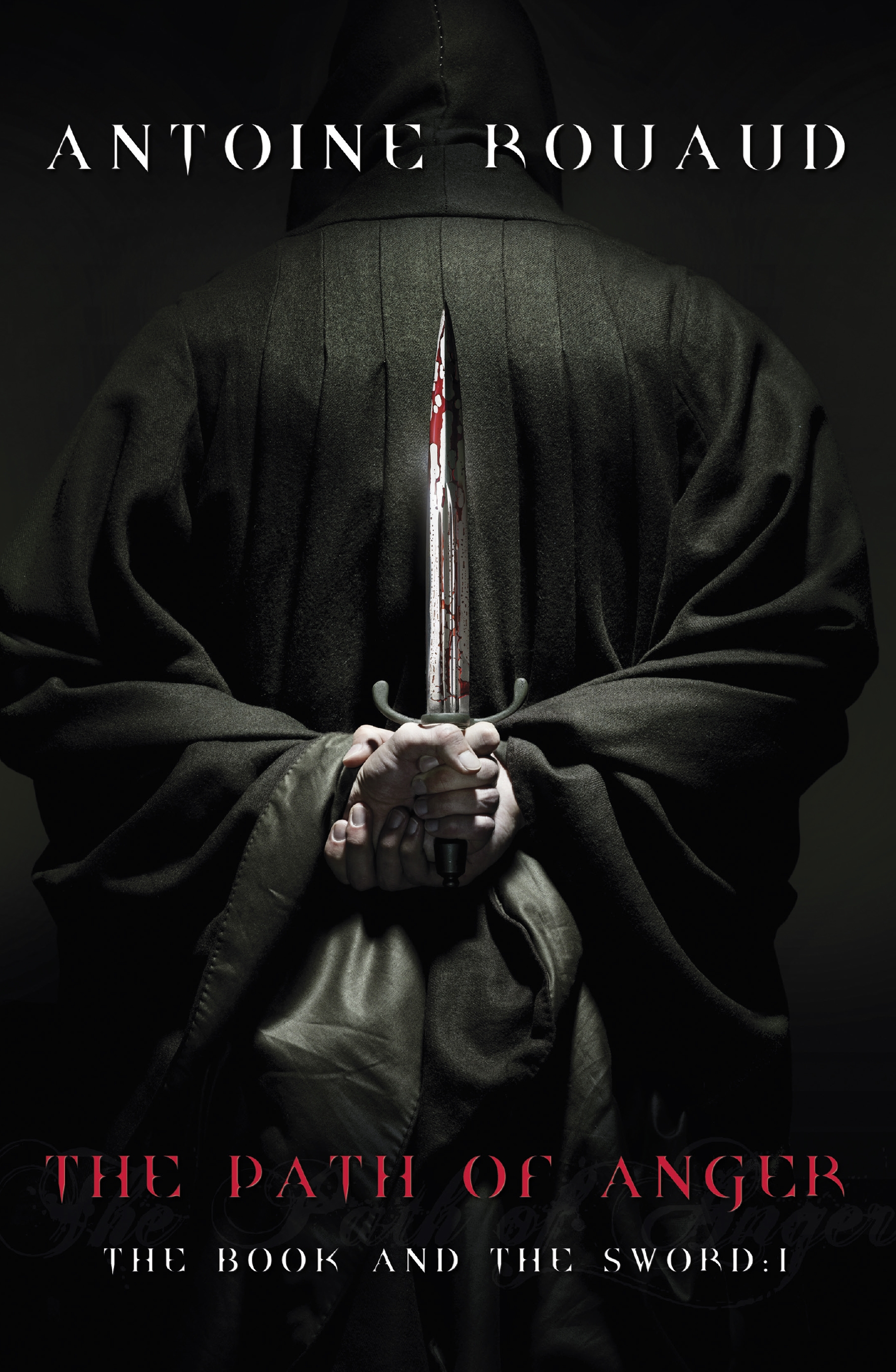
Cool, calm, collected, Antoine Rouaud steps onto the sands shrouded in a drawn hood and full length cloak, one hand curled about a dagger dripping with blood, the other clutching to The Path of Anger, published by Gollancz. In his footsteps follow both knights and assassins, deadly with both blade and magic, and who will let none stand in their way.

Last but certainly not least, especially if he has anything to say about it, is Luke Scull, heralded into the arena by chants of ‘Skull, skull skull!’ as if the baying crowd has already sensed the pull-no-punches savage grit of his debut The Grim Company published by Head of Zeus. The tyro-titan boats his very own grim company of heroes and heroines, barbarians and bastards, dead gods and diehard rebels, spoiling for a fight from the moment he sets foot on the sands.

And that, ladies and gentleman is that! Head on over to the DGLA Official site to show your support for your favourite authors. I'll be reviewing each of the nominations and inviting the authors for both an interview and guest post, for you to learn a little more about them.
 
There’s only one last thing to say…

GLADIATORS…ARE YOU READY?!?
 
Voting closes 31st May.

Monday, 28 April 2014

Book Review: 'The Emperor's Blades' by Brian Staveley.

UK and US covers for 'The Emperor's Blades' by Brian Staveley.
The Good: Nice change from the usual western-medieval setting. An epic start to a new fantasy saga. An ever thickening plot, set in a rich and real world, cast with characters whose stories you don’t just follow but live, too.

The Bad: Would have liked to see more of the Annurian Empire through Adare’s storyline, but this really isn’t criticism but more a curiosity, as I would have liked to discover more about the fully-fleshed world. Kaden’s monk ‘trials’ (as I like to think of them) at times felt more like a reminder of his importance/existence, rather than furthering the plot.

The Ugly Truth: Well deserving of the hype proceeding it, Brian Stavely’s gutsy newcomer ‘The Emperor’s Blades’ doesn’t pull its punches – visceral and break-neck from start to finish. Whilst packing a strong right hook in terms of action and suspense, it’s the subtle knife that slips through your guard as the plot twists again and again.

For Those That Like: Stories in which no-one is safe. Conspiracy and betrayal, clandestine operations, court intrigue, badass monks, and greater powers at war behind it all.

The Emperor is dead.

Murdered...

...Betrayed.

Heir to the unhewn throne, Kaden, is yet to discover his father’s death. For eight years he has trained under the Shin monks, honing the strength of mind over matter. Isolated from the world, atop the Bone Mountains, Kaden and the other monks are unaware of the events tearing apart the empire. But the monks have threats of their own – an unknown creature stalks the mountains, slaughtering livestock in a way that no natural beast can.

Valyn, Kaden’s brother and second-in-line to the throne, is nearing the end of his Kettral training. Soon Valyn will join the elite Kettral ranks, and lead his own Wing on clandestine operations. But on a routine training exercise he uncovers a conspiracy that threatens not only his brother’s life, but the future of the Empire, too. With enemies lurking in the shadows and betrayers in the midst of the Kettral ranks, it’s down to Valyn to save his brother, that is if he isn’t killed first by the assassins… or his own soldierly training.

Adare, Valyn and Kaden’s sister, appointed Minister of Finance within the Empire, is there to witness the trial of her father’s murderer. The accused is no deadly assassin nor common crook, but the high priest of the Empire’s faith. The ensuing trial questions whether the Annurian Empire should be ruled by a mortal Emperor or the will of a god…

And behind it all greater forces are at play. An enemy lost to the pages of history is about to return, and no matter of mortal quarrel can compare to its power to destroy.

War is coming, and no-one is safe...

Brian Staveley’s debut ‘The Emperor’s Blades’ is armed and dangerous. One of the most highly anticipated releases for Q1 2014, the novel has set the standard high for the rest of the year. A mix of fully-fledged-fantasy and the ‘grit’ that has become a popular staple in recent fantasy works, Staveley sets himself apart with a non-western medieval setting, a new breath of life into tried and tested character archetypes, and a magic system that even a d20 and a pen and paper couldn’t predict (in a good way, of course).

‘The Emperor’s Blades’ tells the story of the titular Emperor’s children following his murder. The story centres around the three main PoV characters, the story told from their experiences, the overarching plot interwoven with their individual journeys. The plot thickens as they ‘come-of-age’ in their separate environments.  Kaden in a monastery under the tutelage of Shin monks, Valyn training on a remote isle to join the ranks of the Kettral elite, and Adare navigating the intricacies of politics and plotting as a Minister of the Empire. The Emperor is dead, murdered by the hand of the High Priest. Conspiracy is afoot, one that threatens the Emperor’s children, and the rule of the Empire itself. Kaden, isolated from the outer world due to the remoteness of the monastery, is unaware of his father’s death, and his own sudden inheritance of the unhewn throne. Valyn uncovers the conspiracy through the last words of a dying man, but if he makes it known then he risks escalating the traitors into early execution of their plan. All the while, Adare is party to the trial of her father’s murderer, fighting for justice and not least a little bitter vengeance.

The characters carry the book. Whilst the overarching theme of ‘something evil this way comes’ is ever present, and alluded to in snippets, it’s fair to say that the debut focuses more on Kaden, Valyn and Adare as they complete their tuition and come into their own.

Kaden’s chapters focus on his pursuit of the vaniate – what the monks call ‘The Empty Mind’. Think = blank canvas. The sub-elements of this include a photographic memory, the ability to see the world from another’s perspective, and to ignore the physical presence of the body and emotion, and remain detached to the world around you whilst still interacting with it. Sounds like some monk-matrix-meditative stuff, but this is nicely interwoven to the plot, and I’m looking forward to seeing how Staveley develops this in the future. Kaden’s chapters also link into the greater evil at play, which might not be evil in the sense of black leathers, eye of newt, and pointy horns, but it still spells doom-and-gloom to the human race all the same.

Valyn’s story, to me, is the most interesting. As a recruit-in-training, we follow him on exercises, and later the trials, required to become a Kettral. The Kettral are an elite group of soldiers, formed of snipers, magic-using leaches, demolitions experts, weapons specialists, and birds with 70ft wingspans (pilots not included with each bird purchase, but required all the same). I’d liken them to squad-based ninja-legionnaires crossed with modern-day marines and paratroopers. From my own experiences I am more than happy to report that Staveley handled the military elements more than adequately, introducing enough black humour, barrack slang, and cussing, without going overboard and boiling it down into over-used stereotypes that only know how to curse colourfully and stab people. Valyn is the one to uncover the conspiracy to kill the Emperor’s heirs, and it’s down to him to save him brother (and sister!) before the traitors take over.

Adare’s involvement is limited to the Imperial Court and City. And I say limited carefully. It’s not a criticism in this book, as her role is to tie-in the trial of the Emperor’s murder, but if there was space for further ‘world building’ then I’d argue it’s her pages. Staveley’s world is rich with unique creations – from the unhewn throne to the Skullsworn assassins and the pantheon of gods – and being set in a non-western medieval backdrop, I’d have liked to see more of this. After all, it’s one of the key differences between this book and the current fantasy-offering in the market e.g. yet another Game of Thrones copy, or Elves, Dwarves and Dark Lords aplenty.

The story is executed with all vigour and excitement of a newblood, and whilst Staveley succumbs to a few rookie ‘stumbles’(I won’t say amateur, as it’s clear he’s put in a lot more effort than some of the professionals), the finished product is a breakneck race to the finish line. It’s by no means a short read, coming in at over 450 pages, but the chapters (particularly Valyn’s) fly by thanks to the author’s calculated pacing.

From what I’ve read, it’s safe to say that ‘The Emperor’s Blades’ has well earned its hype, and its high time that the author be recognised as a rising star in the fantasy field. I for one am looking forward to the second book, as now that the scene is set I want to see where Staveley takes it next.

Sunday, 27 April 2014

Guest Post: 'Gandalf's Hand Sanitizer' by Brian Staveley


Yesterday I introduced you to the one and only Brian Staveley - writer, editor, father, teacher (in no particular order, of course). Brian's a busy man, and when he's not doing any of the above he's sharing his thoughts and opinions on topics within the fantasy genre. From swearing in fantasy to what motivates the bad guys, Brian isn't afraid to sugar coat his insight into the fantasy realm. It's a refreshing take on things that we either overlook or forgive our favourite authors for. Brian posts these articles on his blog, but he was kind enough to submit one here, on Written-With-A-Sword.

So, without further ado, I give you Brian Stately and 'Gandalf's Hand Sanitizer - The Wounds of Fantasy.'

A very partial list of the things that could kill you in the absence of modern medicine: bees, thorns, nuts, horses, mosquitoes, childbirth, chicken, spinach, farming, dogs, rats, rusty tacks, ticks, and shit.*
 
If you live in a part of the world without access to cipro and epi pens, doxycycline and tetanus shots, penicillin and measles vaccines, chances are one of these things will kill you. To feel the gravity of the situation, just try the following experiment: go somewhere remote. Hike a week into the backcountry or get dropped off by a float plane. Now break your leg with a rock. Take notes about the experience so the rest of us can appreciate your observations after your death, which will probably be imminent. Without a hospital nearby, a broken leg can be a death sentence. In fact, everything starts to look like a potential death sentence. Appendicitis is easily treatable when you live in Columbus, Ohio. Get it while mountaineering in the Brooks Range and you die.
 
In traditional epic fantasy, of course, no one has access to modern medicine. You’d rarely know that, though, from the way the characters carry on. Wounded soldiers will occasionally battle infection, the odd woman will die in childbirth, but by and large the heroes and villains appear blithely unconcerned by the mortal threats surrounding them. During the American Civil War, two out of every three soldiers fell to disease or infection.  When was the last time you saw a fantasy character die of tetanus? Or malaria? Or anaphylactic shock? Or salmonella?
 
I get it, of course. A fantasy novel in which the main characters languish in the grip of chronic illness hardly sounds like delightful reading. If the Lord of the Rings played out in the real world, Sam would collapse of dengue fever contracted in the Dead Marshes, Gollum would be long dead from some raw-trout-borne illness, and Frodo, rescued from the taint of the Morgul-blade, would succumb to a staph infection. No one wants to read that book, least of all me.
 
Moreover, to be fair to writers of fantasy, magic often fills the void left by the absence of modern medicine. Lizard men leave a nasty gash in your shoulder? Heal it up with a little magic salve. The unpleasant end of a dagger stuck in your leg? Have the local witch lay hands on it. That arrow straight through the gut? A few runes and a muttered incantation ought to do the trick. This is the whole point of healers and potions in games like Elder Scrolls. Without magic no one would ever win. Ever.
 
The magic-as-medicine approach works, and can work elegantly. It does, however, invite a sort of macabre escalation. When the rules of healing are murky, there’s no reason for an author not to raise the stakes in every battle, and it is oh, so tempting to raise the stakes. The escalation of physical violence is an ancient authorial impulse – Beowulf isn’t content to wrestle Grendel; he rips his entire arm off and hangs it from rafters – but it’s encouraged by the calibration of the modern reader.
 
If you cut sliced your hand open with a dirty knife tomorrow, you’d probably be irritated but not terrified. The most inept emergency room in America could have you out the door in an hour and your life expectancy would be excellent. As a result, a slashed up hand just doesn’t impress us. We’d be pissed off if Aragorn keeled over from an injury incurred during food preparation.
 
In fourteenth century, however, a knife wound was serious shit. If you hacked into your palm while gutting a goat, there wasn’t much to do but stare at the wound, offer a prayer, and try really hard not to die. And if mortality rates are any indication, the stare-prayer-try method wasn’t all that reliable.
 
Hence an interesting predicament: modern writers and readers of fantasy are out of tune with the gravity of the injuries about which we read and write. Wounds large enough to impress our super-size sensibilities would almost certainly annihilate any character without magical protection. Plausible wounds, on the other hand, are boring.
 
This isn’t a call to action. As I said above, I don’t really want to read a whole lot of books in which elite mystical assassins succumb to the ravages of food poisoning. Great battles and horrifying wounds are a staple of the genre (all of which is quite bullish for the potion-brewers and incantation-mutterers), but I’m sure that Gandalf has room, somewhere in that voluminous robe of his, for a small bottle of Purell.
 
* A good example, incidentally, of the value of the Oxford comma, which places beyond all doubt the idea that the ticks can kill independently of the shit. Although I’m sure that shit-dipped ticks could also be deadly.
 
Brian Staveley's debut 'The Emperor's Blades' is published by Tor, and is available from all major bookstores and Amazon. 
You can find out more about Brian on his blog bstaveley.wordpress.com.